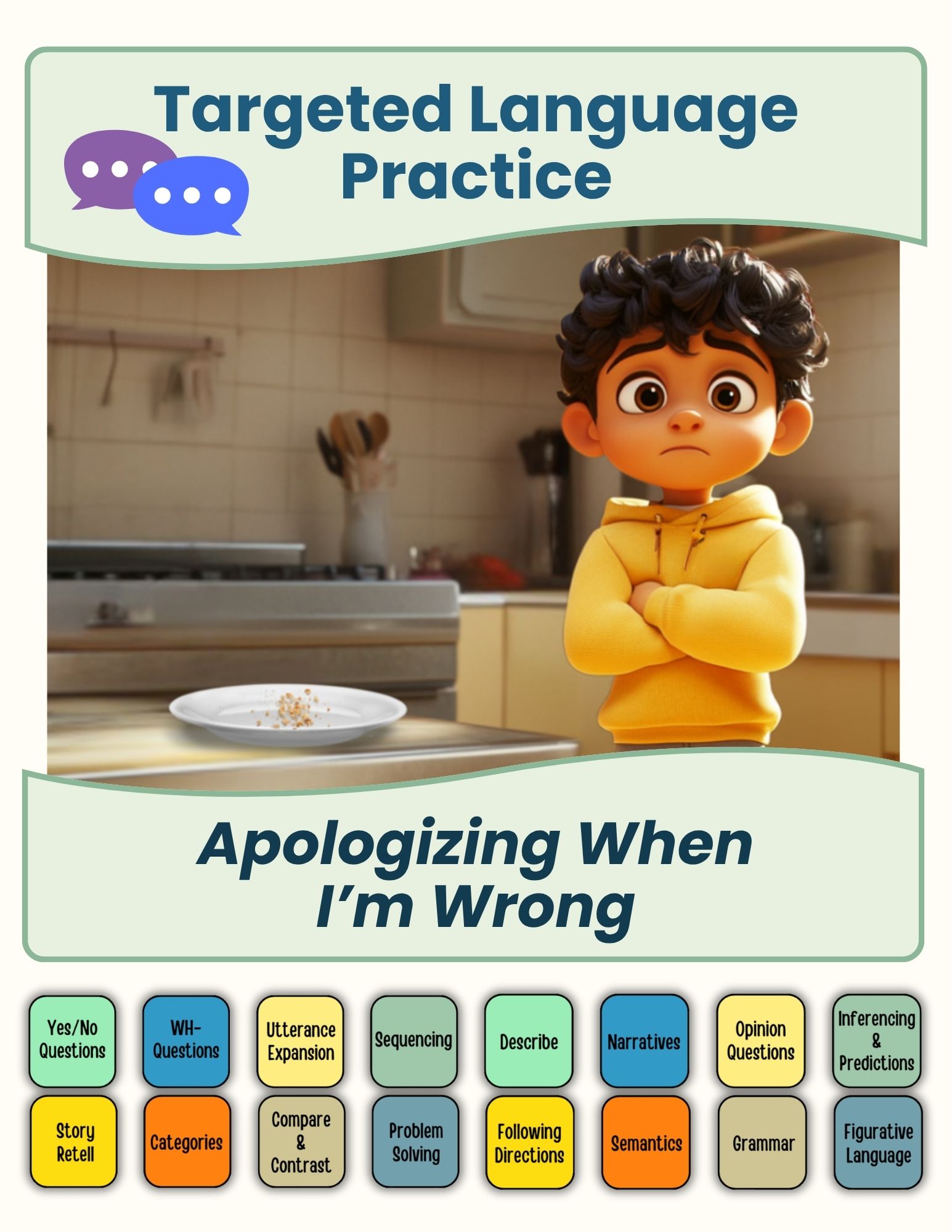
Apologizing When I’m Wrong

About This Video

Apologizing When I’m Wrong is a supportive life skills video that helps children learn how to apologize after making a mistake or hurting someone. This video teaches learners to notice the problem, take responsibility, use sincere words, try to fix the problem, and understand that apologizing helps keep relationships strong.

Learning Objectives

After watching this video, learners will:

  1. Understand that everyone makes mistakes and that it’s okay
  2. Recognize when an action or word may have hurt someone else
  3. Learn what it means to take responsibility for a mistake
  4. Identify the three parts of a good apology
  5. Practice saying an apology using respectful and honest language
  6. Understand that others may need space after an apology
  7. Build self-awareness and social responsibility through reflection and repair

Resources for This Video

Use these resources to extend learning and build communication skills.

A digital guide with key concepts, visual supports, and review questions.

View Learning Guide

Practice language skills with targeted activities connected to the video.

Practice Language Skills

Clinician & Educator Supports

Kindergarten
CCSS.ELA-LITERACY.SL.K.1 – Participate in collaborative conversations
CCSS.ELA-LITERACY.SL.K.6 – Speak audibly and express thoughts, feelings, and ideas clearly
CCSS.ELA-LITERACY.L.K.6 – Use words and phrases acquired through conversations

Grade 1
CCSS.ELA-LITERACY.SL.1.1 – Participate in collaborative conversations
CCSS.ELA-LITERACY.SL.1.4 – Describe people, places, things, and events with relevant details
CCSS.ELA-LITERACY.L.1.6 – Use words and phrases acquired through conversation

Grade 2
CCSS.ELA-LITERACY.SL.2.1 – Participate in collaborative conversations
CCSS.ELA-LITERACY.SL.2.4 – Tell a story or recount an experience with appropriate facts and details
CCSS.ELA-LITERACY.L.2.6 – Use acquired words and phrases to describe actions and emotions

Grade 3
CCSS.ELA-LITERACY.SL.3.1 – Engage in collaborative discussions
CCSS.ELA-LITERACY.SL.3.4 – Report on a topic or tell a story with appropriate facts and details
CCSS.ELA-LITERACY.L.3.6 – Use conversational and academic vocabulary to express understanding

Grade 4
CCSS.ELA-LITERACY.SL.4.1 – Engage effectively in discussions
CCSS.ELA-LITERACY.SL.4.4 – Report on a topic or present a point of view clearly
CCSS.ELA-LITERACY.L.4.6 – Use precise language and domain-specific vocabulary

Grade 5
CCSS.ELA-LITERACY.SL.5.1 – Participate in discussions, building on others’ ideas
CCSS.ELA-LITERACY.SL.5.4 – Report on a topic or present an opinion logically and clearly
CCSS.ELA-LITERACY.L.5.6 – Use vocabulary to express ideas and emotions accurately

Grade 6
CCSS.ELA-LITERACY.SL.6.1 – Participate in collaborative discussions
CCSS.ELA-LITERACY.SL.6.4 – Present claims and findings with clear organization and reasoning
CCSS.ELA-LITERACY.L.6.6 – Use general academic and domain-specific vocabulary

Grade 7
CCSS.ELA-LITERACY.SL.7.1 – Engage in collaborative discussions
CCSS.ELA-LITERACY.SL.7.4 – Present claims and findings logically with relevant descriptions and examples
CCSS.ELA-LITERACY.L.7.6 – Use vocabulary to clearly express ideas and emotions

Grade 8
CCSS.ELA-LITERACY.SL.8.1 – Initiate and participate in collaborative discussions
CCSS.ELA-LITERACY.SL.8.4 – Present ideas with logical organization, appropriate eye contact, and formal style
CCSS.ELA-LITERACY.L.8.6 – Use precise language and vocabulary to express understanding and responsibility

  • The student will name the three parts of a good apology in 4 out of 5 structured trials with visual prompts by [date].
  • The student will identify a situation where an apology is needed and explain why in 3 out of 4 guided discussions by [date].
  • The student will role-play giving a complete, respectful apology using the 3-step model in 4 out of 5 structured opportunities by [date].
  • The student will describe how it feels to apologize and how it can help others feel better in 3 out of 4 reflective discussions by [date].
  • The student will identify one way to make a situation better after apologizing in 3 out of 4 activities by [date].
  • The student will demonstrate understanding that it is okay for others to need time or space after an apology in 4 out of 5 scenarios by [date].

Keep Learning

Explore more videos that build related skills.