
Building Emotional Vocabulary Through Evening Routines
Evening routines are more than just brushing teeth and turning out the lights. They are powerful opportunities to help children understand different emotions, strengthen their emotional intelligence, and even begin simple practices of mindfulness. With the right support, these nightly moments can set the stage for calmer bedtimes, stronger connections, and healthier emotional growth.
At Huckleberry Bridge Learning, we’ve created life skills video lessons like Listening to a Bedtime Story, Evening Family Time, and Falling Asleep to make evening routines not only smoother, but also richer in social and emotional learning.
Why Emotional Vocabulary Matters
Children often feel many different emotions in a single day—joy, frustration, pride, disappointment. Without the words to describe those feelings, they may act out or withdraw instead of communicating what’s going on inside. When children build emotional vocabulary, they:
- Recognize what they are feeling.
- Express those feelings clearly to others.
- Regulate emotions in healthy ways.
This foundation is the building block of emotional intelligence. Research shows that when children name emotions, their stress decreases and their ability to self-regulate increases. Parents and educators who model emotional language and encourage children to share their feelings help strengthen these lifelong skills.
The Power of Evening Routines
Evening routines are especially powerful because they provide calm, predictable structure. Research highlights that:
- Consistency builds security. Children with predictable bedtime routines show fewer behavioral difficulties and stronger self-regulation (Mindell et al., 2017; Lam et al., 2023).
- Rituals nurture connection. Shared evening activities like reading or family conversation strengthen language, empathy, and family bonds (Selman et al., 2024).
- Routines promote wellbeing. Consistent bedtime practices are linked to emotional stability, school readiness, and even better family dynamics (Kitsaras et al., 2018).
When children know what to expect, they feel safe. This sense of safety makes it easier to talk about feelings and practice simple mindfulness strategies, such as taking slow breaths or noticing how their body feels as they prepare for sleep.
Narrative-Based Learning as an Emotional Bridge
Watching or listening to calming evening learning videos is one of the most effective ways to explore emotions at night.
- Expanding emotional vocabulary. Fuided learning videos give children safe ways to encounter different emotions—happy, sad, worried, calm—and connect them to real-life experiences.
- Boosting empathy. Research shows narrative-based learning builds Theory of Mind, the ability to understand other people’s thoughts and feelings (Solichah & Suminar, 2020).
- Strengthening resilience. Narrative-based interventions have been shown to help children regulate emotions and build protective social-emotional skills (Ramamurthy, 2024).
- Supporting mindfulness. Listening to calm narration, focusing on the flow of the guided lesson, and reflecting on feelings are natural ways to practice mindfulness as part of the bedtime routine.
Evening Routine Video Lessons
Listening to a Bedtime Story
This video lesson helps children slow down, listen attentively, and connect with characters’ different emotions, encouraging both empathy and focus.

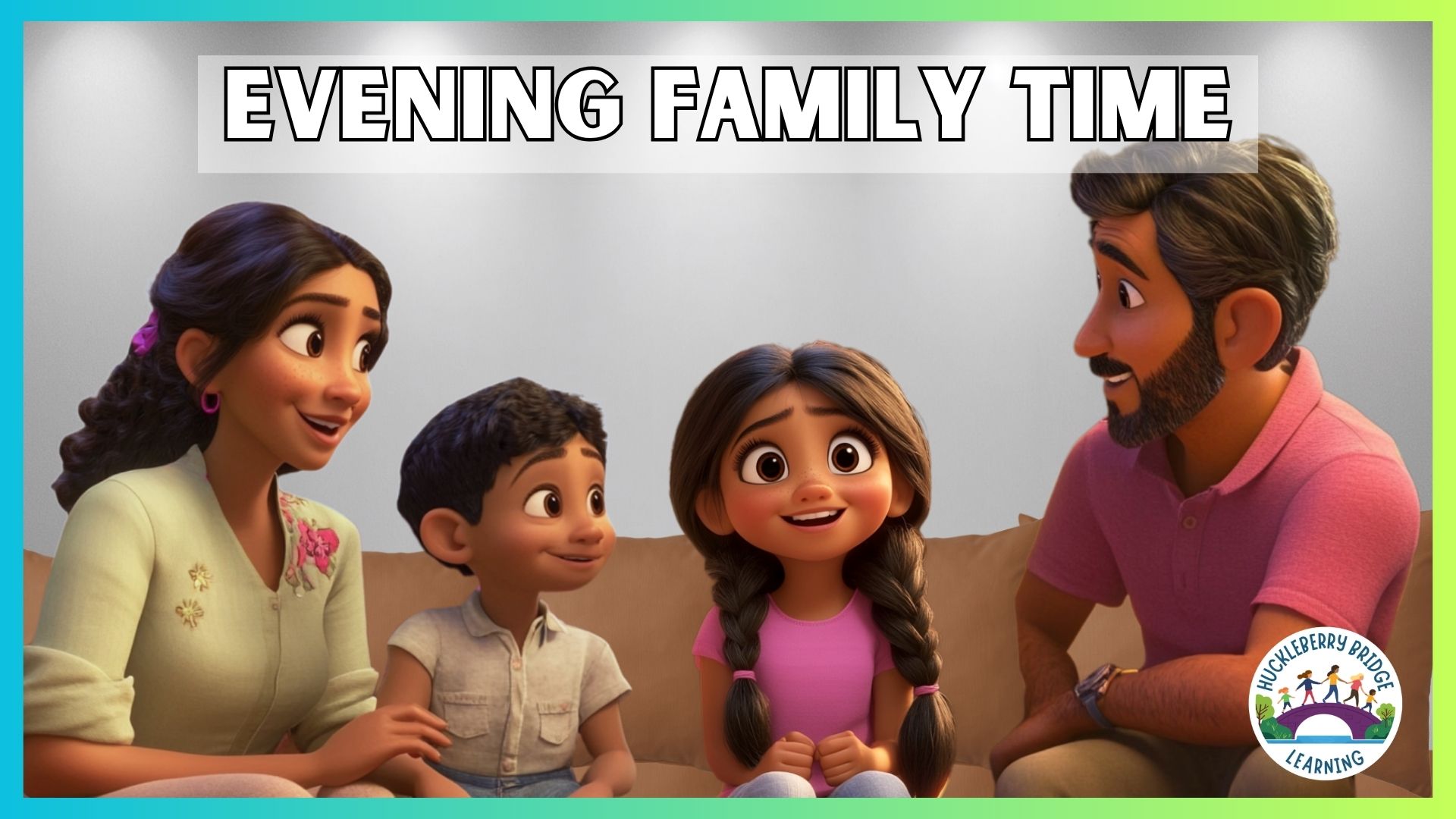
Evening Family Time
Whether sharing about the day or simply sitting together, this video lesson highlights how family rituals strengthen emotional intelligence and communication.
Falling Asleep
This lesson gently reassures children who may feel restless or anxious. By modeling calm breathing and positive self-talk, it promotes relaxation, self-awareness, and mindfulness.

Tips for Parents and Educators
- Name emotions in the moment. “You look excited about that video,” or “I feel calm sitting here with you.”
- Use video lessons as conversation starters. Pause to ask, “How do you think this character feels?” or “Have you ever felt that way?”
- Encourage reflection. Ask: “What was your happiest moment today?” or “What frustrated you?”
- Model mindfulness. Take a slow breath together before bed, or stretch gently while talking about the day.
The Evening Bridge
Evening routines are more than a checklist—they’re a bridge between the busyness of the day and the calm of night. By weaving in storytelling, emotional language, and simple mindfulness practices, families and educators can help children build stronger emotional vocabulary and grow in emotional intelligence.
Our Life Skills Video Library is growing with video lessons that make these everyday routines easier and more meaningful. From Listening to a Bedtime Story to Evening Family Time and Falling Asleep, each lesson is designed to support children’s emotional development—one evening at a time.
👉 Explore more at HuckleberryBridge.com and discover our life skills videos and companion activities for building emotional growth and confidence.
References
-
Hale, L., Berger, L. M., LeBourgeois, M. K., & Brooks-Gunn, J. (2011). A longitudinal study of preschoolers’ language-based bedtime routines, sleep duration, and well-being. Journal of Family Psychology, 25(3), 423–433.
https://pmc.ncbi.nlm.nih.gov/articles/PMC3134391/ -
Kitsaras, G., Goodwin, M., Allan, J., Kelly, M. P., & Pretty, I. A. (2018). Bedtime routines child wellbeing & development: A systematic review. BMC Public Health, 18, 529.
https://bmcpublichealth.biomedcentral.com/articles/10.1186/s12889-018-5290-3 -
Lam, J., Leung, C. Y., & Mindell, J. A. (2023). Bedtime routines and emotional-behavioral regulation: Evidence from a longitudinal study. Frontiers in Sleep, 2, 1197297.
https://www.frontiersin.org/journals/sleep/articles/10.3389/frsle.2023.1197297/full -
Mindell, J. A., Telofski, L. S., Wiegand, B., & Kurtz, E. S. (2009/2017 update). A nightly bedtime routine: Impact on sleep in young children and maternal mood. Sleep, 32(5), 599–606.
https://pmc.ncbi.nlm.nih.gov/articles/PMC6587181/ -
Ramamurthy, S. (2024). Storytelling and resilience: A systematic review of the role of narrative in children’s social-emotional development. Children and Youth Services Review, 157, 107160.
https://pubmed.ncbi.nlm.nih.gov/38087837/ -
Selman, R. L., McGill, M., & Fiese, B. H. (2024). Family routines and child outcomes: A systematic review and meta-analysis. Journal of Family Theory & Review, 16(1), 77–98.
https://onlinelibrary.wiley.com/doi/10.1111/jftr.12549 -
Solichah, R., & Suminar, D. R. (2020). Daily storytelling improves preschoolers’ theory of mind. Proceedings of the International Conference on Early Childhood Education.
https://www.scitepress.org/Papers/2018/85878/85878.pdf