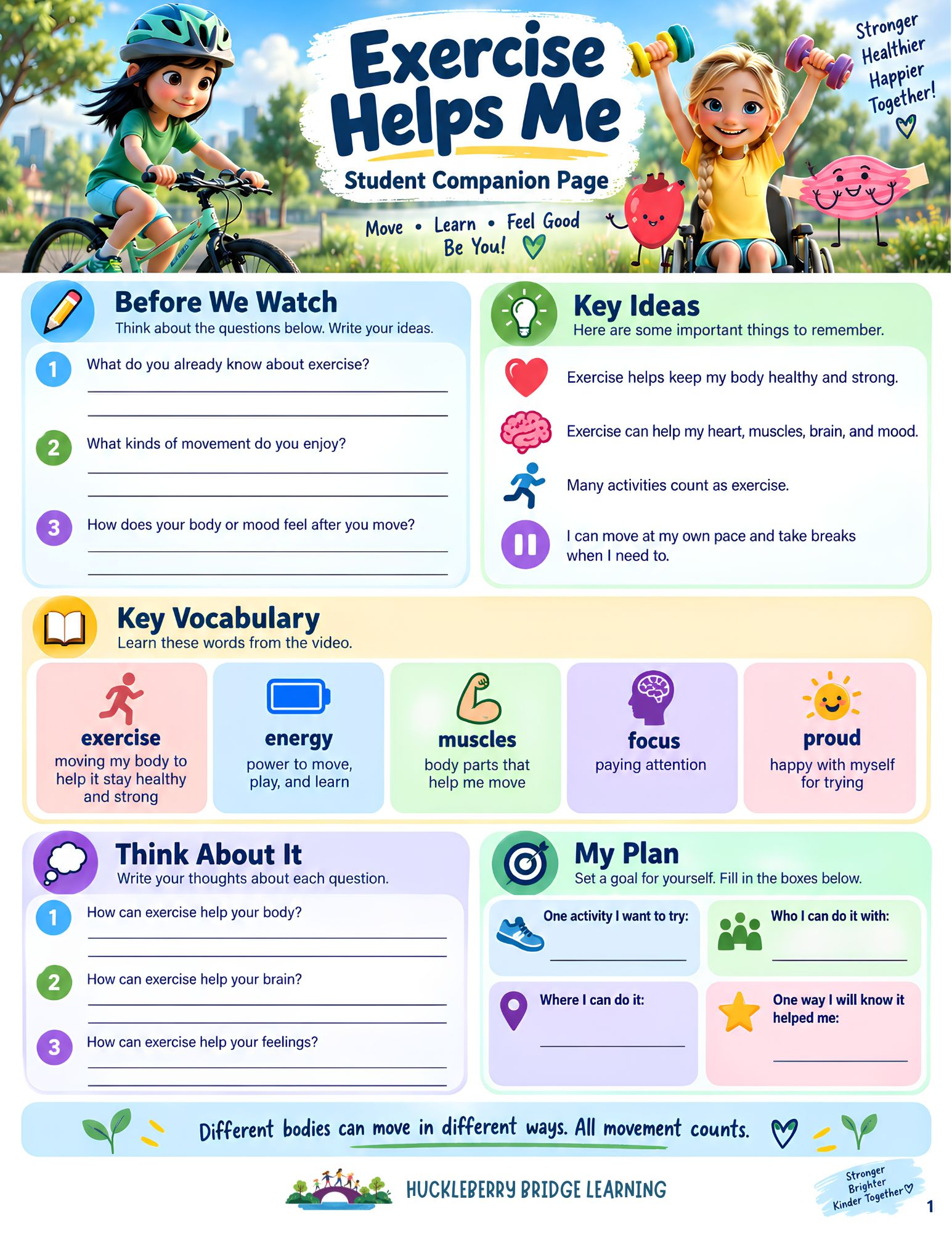
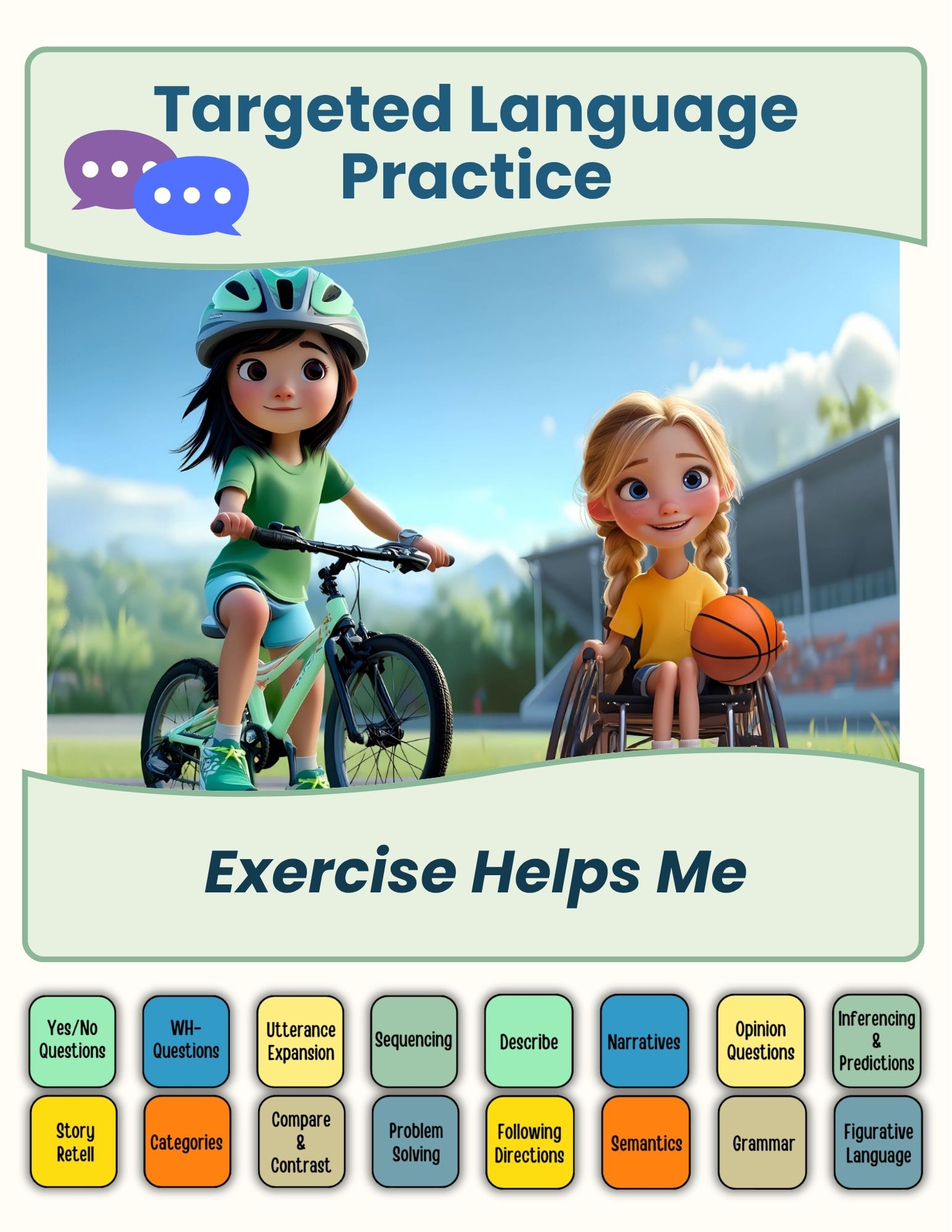
Exercise Helps Me

Health and Well-being

Pre-K, Elementary, Middle School, High School

Learning Objectives
  1. Identify different types of physical activities that count as exercise
  2. Explain how exercise helps the body stay strong and healthy
  3. Describe how movement can improve mood and focus
  4. Recognize that everyone can exercise in their own way
  5. Demonstrate ways to include movement in everyday routines
  6. Understand that exercise can be fun and part of self-care
  7. Acknowledge that both big and small movements are helpful
  8. Show respect and encouragement for how others choose to be active
  9. Build confidence in trying new ways to move and stay active
  10. Learn that regular movement supports both physical and mental health

Kindergarten
CCSS.ELA-LITERACY.SL.K.1
Participate in collaborative conversations with diverse partners about kindergarten topics and texts with peers and adults in small and larger groups.
CCSS.ELA-LITERACY.SL.K.2
Confirm understanding of a text read aloud or information presented orally or through other media by asking and answering questions about key details.
CCSS.ELA-LITERACY.SL.K.4
Describe familiar people, places, things, and events and, with prompting and support, provide additional detail.

Grade 1
CCSS.ELA-LITERACY.SL.1.1
Participate in collaborative conversations with diverse partners about grade 1 topics and texts with peers and adults in small and larger groups.
CCSS.ELA-LITERACY.SL.1.2
Ask and answer questions about key details in a text read aloud or information presented orally or through other media.

Grade 2
CCSS.ELA-LITERACY.SL.2.1
Participate in collaborative conversations with diverse partners about grade 2 topics and texts with peers and adults in small and larger groups.
CCSS.ELA-LITERACY.SL.2.2
Recount or describe key ideas or details from a text read aloud or information presented orally or through other media.

Grade 3
CCSS.ELA-LITERACY.SL.3.1
Engage effectively in a range of collaborative discussions with diverse partners on grade 3 topics and texts, building on others’ ideas and expressing their own clearly.
CCSS.ELA-LITERACY.SL.3.2
Determine the main ideas and supporting details of a text read aloud or information presented in diverse media and formats.

Grade 4
CCSS.ELA-LITERACY.SL.4.1
Engage effectively in a range of collaborative discussions with diverse partners on grade 4 topics and texts, building on others’ ideas and expressing their own clearly.

Grade 5
CCSS.ELA-LITERACY.SL.5.1
Engage effectively in a range of collaborative discussions with diverse partners on grade 5 topics and texts, building on others’ ideas and expressing their own clearly.

Grade 6
CCSS.ELA-LITERACY.SL.6.1
Engage effectively in a range of collaborative discussions with diverse partners on grade 6 topics, texts, and issues, building on others’ ideas and expressing their own clearly.

Grade 7
CCSS.ELA-LITERACY.SL.7.1
Engage effectively in a range of collaborative discussions with diverse partners on grade 7 topics, texts, and issues, building on others’ ideas and expressing their own clearly.

Grade 8
CCSS.ELA-LITERACY.SL.8.1
Engage effectively in a range of collaborative discussions with diverse partners on grade 8 topics, texts, and issues, building on others’ ideas and expressing their own clearly.
  • The student will identify at least three forms of exercise and describe their benefits using complete sentences in 4 out of 5 opportunities with minimal prompting by [date].
  • The student will answer simple wh-questions (who, what, where, why) related to the video content with 80% accuracy across 3 sessions by [date].
  • The student will describe how exercise helps the body or brain using at least two descriptive details in 3 out of 4 opportunities by [date].
  • The student will use targeted vocabulary (e.g., exercise, movement, strong, healthy) in structured conversation or sentence completion tasks in 4 out of 5 opportunities over 2 consecutive sessions by [date].
  • The student will identify one way they personally enjoy moving their body and explain why in a complete sentence in 3 out of 5 trials with visual support by [date].
  • The student will respond to peer or adult comments about exercise using appropriate turn-taking language (e.g., “Me too,” “I like that,” “I do that too”) in 80% of opportunities during role-play by [date].
  • The student will sequence three to four steps in a simple physical activity (e.g., stretching, dancing) and describe them using transition words with 70% accuracy over 2 sessions by [date].
  • The student will make a personal connection to the video by sharing an example of when they exercised, in 3 separate sessions, using a beginning, middle, and end by [date].
  • The student will demonstrate understanding of inclusive movement by identifying two ways people with different abilities can stay active with 80% accuracy over 2 therapy sessions by [date].
  • The student will initiate or participate in a structured discussion about exercise and healthy habits with peers or adults in a group setting in 3 out of 4 observed opportunities by [date].

Related Companion Activity