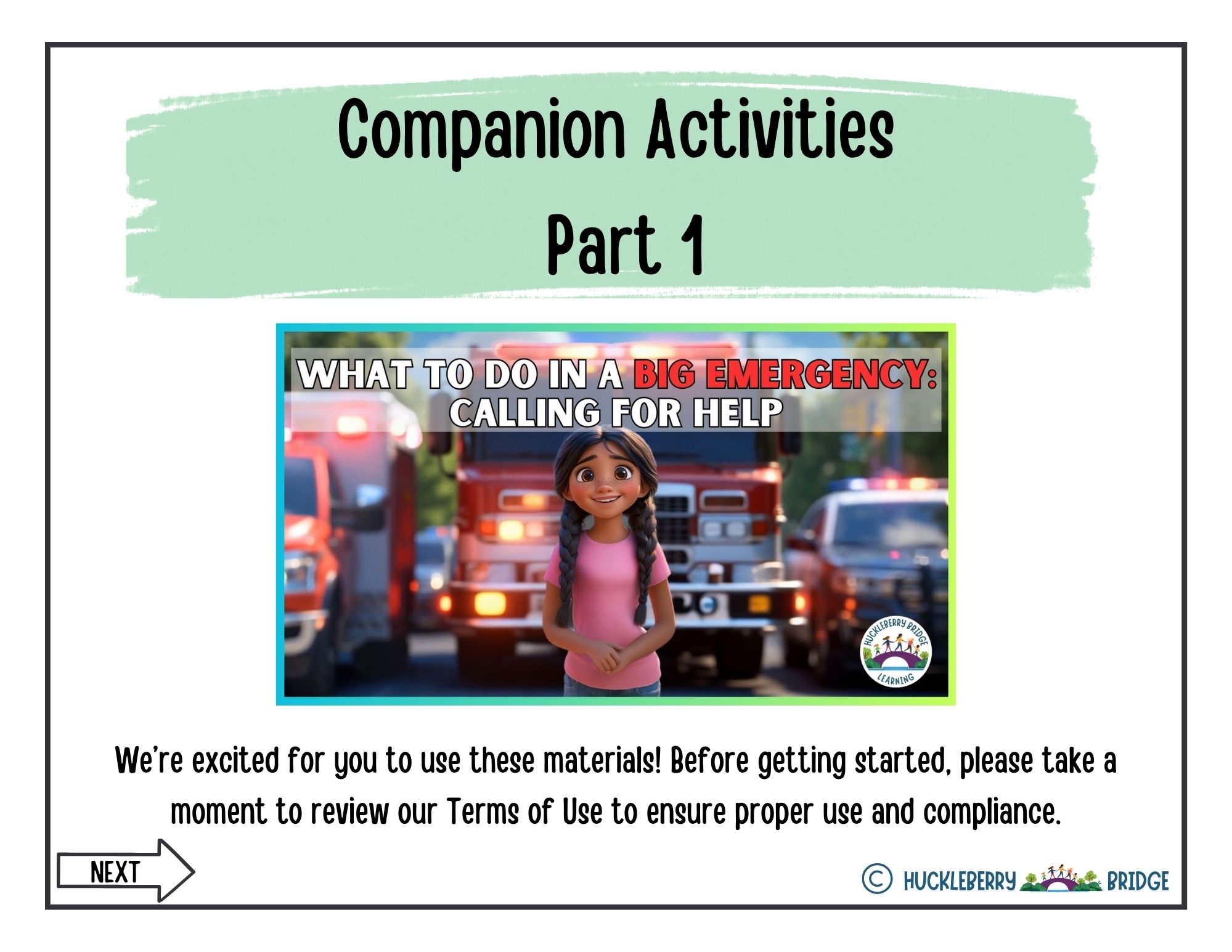
What to Do in a Big Emergency: Calling for Help

Safety and Awareness

Pre-K, Elementary, Middle School, High School

Learning Objectives
  1. Recognize what a big emergency is and how it is different from a small or medium-size problem
  2. Identify common examples of big emergencies, such as fire, injury, or someone not waking up
  3. Explain the importance of staying calm in an emergency situation
  4. Demonstrate how to call 911 using a phone
  5. Recall key information to share when calling 911, including name, location, and what happened
  6. Understand that emergency responders like police, firefighters, and paramedics will be sent to help
  7. Follow directions given by a 911 dispatcher in a role-play or structured activity
  8. Describe how calling 911 helps keep themselves and others safe
  9. Build confidence in knowing what to do when a big emergency happens

Kindergarten
CCSS.ELA-LITERACY.SL.K.1 – Participate in collaborative conversations with diverse partners about kindergarten topics and texts
CCSS.ELA-LITERACY.SL.K.2 – Confirm understanding of information presented orally through questioning
CCSS.ELA-LITERACY.SL.K.4 – Describe familiar people, places, things, and events with detail
CCSS.ELA-LITERACY.L.K.6 – Use words and phrases acquired through conversations and being read to

Grade 1
CCSS.ELA-LITERACY.SL.1.1 – Participate in collaborative conversations with diverse partners
CCSS.ELA-LITERACY.SL.1.2 – Ask and answer questions about key details in information presented orally
CCSS.ELA-LITERACY.SL.1.4 – Describe people, places, things, and events with relevant details
CCSS.ELA-LITERACY.L.1.6 – Use acquired vocabulary in speaking and listening activities

Grade 2
CCSS.ELA-LITERACY.SL.2.1 – Participate in collaborative conversations with peers and adults in small and larger groups
CCSS.ELA-LITERACY.SL.2.3 – Ask and answer questions about what a speaker says to clarify understanding
CCSS.ELA-LITERACY.SL.2.4 – Tell a story or recount an experience with appropriate facts and descriptive details

Grade 3
CCSS.ELA-LITERACY.SL.3.1 – Engage effectively in a range of collaborative discussions
CCSS.ELA-LITERACY.SL.3.4 – Report on a topic or tell a story with appropriate facts and relevant details
CCSS.ELA-LITERACY.L.3.6 – Acquire and use grade-appropriate conversational and academic vocabulary

Grade 4
CCSS.ELA-LITERACY.SL.4.1 – Engage effectively in collaborative discussions
CCSS.ELA-LITERACY.SL.4.4 – Report on a topic or tell a story in an organized manner using appropriate facts
CCSS.ELA-LITERACY.L.4.6 – Use vocabulary to express ideas clearly and effectively

Grade 5
CCSS.ELA-LITERACY.SL.5.1 – Participate in discussions, building on others’ ideas and expressing their own clearly
CCSS.ELA-LITERACY.SL.5.4 – Report on a topic or present an opinion with logical sequencing and supporting details
CCSS.ELA-LITERACY.L.5.6 – Use academic and domain-specific language effectively

Grade 6
CCSS.ELA-LITERACY.SL.6.1 – Engage effectively in collaborative discussions
CCSS.ELA-LITERACY.SL.6.4 – Present ideas and findings with relevant evidence in a focused, organized manner
CCSS.ELA-LITERACY.L.6.6 – Use precise vocabulary to communicate effectively

Grade 7
CCSS.ELA-LITERACY.SL.7.1 – Participate in discussions by posing questions and building on others’ ideas
CCSS.ELA-LITERACY.SL.7.4 – Present claims and findings with logical reasoning and relevant detail
CCSS.ELA-LITERACY.L.7.6 – Use grade-level academic vocabulary clearly and precisely

Grade 8
CCSS.ELA-LITERACY.SL.8.1 – Engage in collaborative discussions with diverse partners
CCSS.ELA-LITERACY.SL.8.4 – Present ideas and findings clearly and logically with appropriate detail
CCSS.ELA-LITERACY.L.8.6 – Use academic and domain-specific language effectively to express ideas

  • The student will identify at least three examples of a big emergency (e.g., fire, injury, someone not waking up) with 80% accuracy during structured tasks by [date].
  • The student will explain the difference between a big emergency and a non-emergency in 3 out of 4 trials using verbal or visual supports by [date].
  • The student will demonstrate how to call 911 and state at least three key pieces of information (what happened, name, location) in role-play scenarios by [date].
  • The student will respond to three wh-questions (who, what, where) about a big emergency scenario with 80% accuracy by [date].
  • The student will follow 2-step directions during an emergency role-play activity in 4 out of 5 opportunities by [date].
  • The student will describe how police, firefighters, or paramedics can help during an emergency in 3 out of 4 opportunities by [date].
  • The student will use calming strategies (e.g., deep breath, self-talk) during emergency-themed role-play or discussions in 4 out of 5 trials by [date].
  • The student will communicate a need for help by initiating a request or selecting a response using verbal language or AAC in response to an emergency prompt by [date].
  • The student will sequence the steps for calling 911 using pictures or verbal explanation in correct order in 3 out of 4 opportunities by [date].
  • The student will participate in a structured discussion about emergency safety with peers or adults, contributing at least two relevant comments by [date].

Related Companion Activity