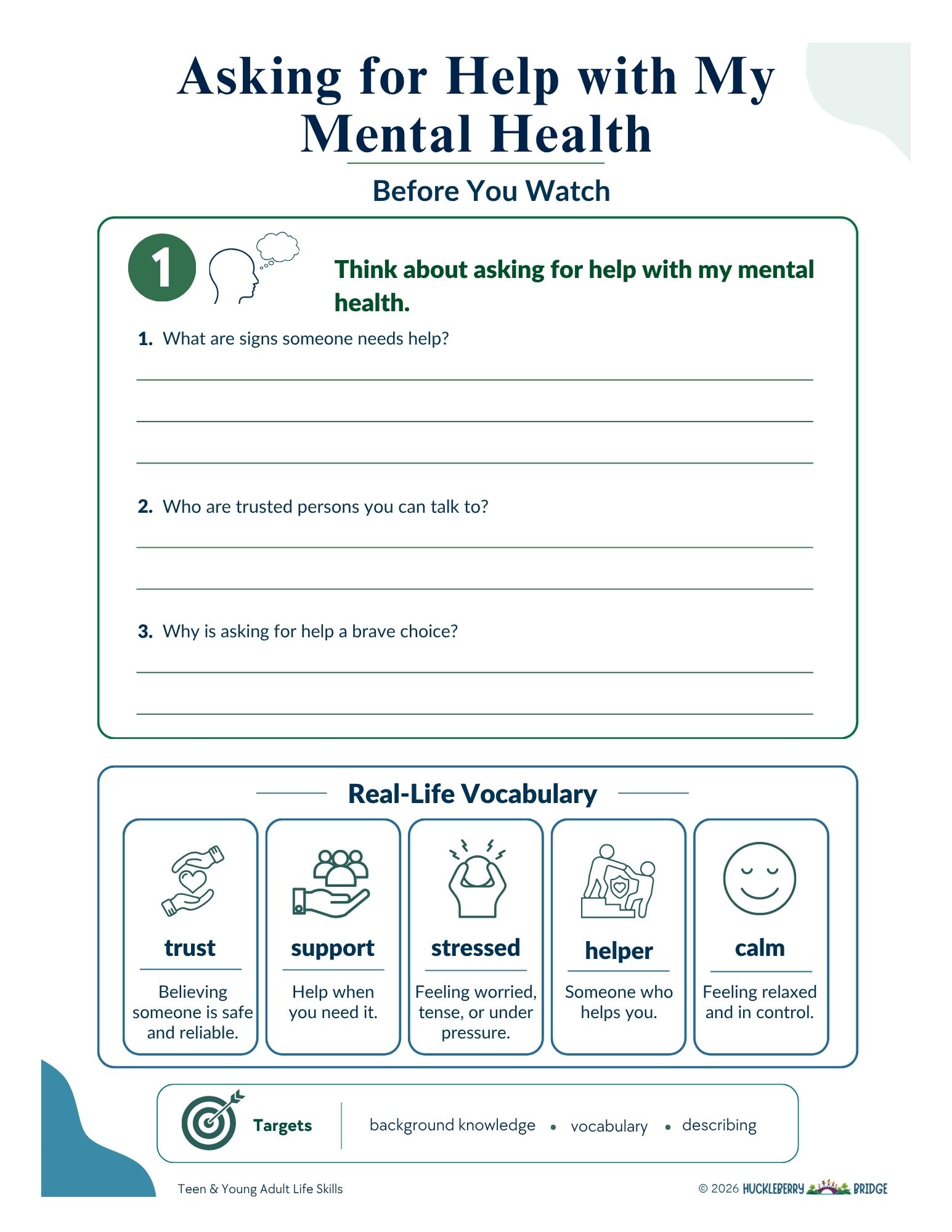
Asking for Help with My Mental Health

About This Video

Asking for Help with My Mental Health teaches learners that asking for support is a strong and responsible choice. This video helps learners recognize when feelings may be too big, last a long time, or make everyday activities harder. It models simple ways to ask for help, such as talking to a trusted person, writing a message, sending a text, or asking for support making an appointment.

Learning Objectives

After watching this video, learners will:

  1. Identify the key communication or relationship skill presented in accepting “no” from someone else.
  2. Distinguish helpful, respectful responses from responses that may create a problem.
  3. Use appropriate words or actions to apply the skill in an everyday situation.

Resources for This Video

Use these resources to extend learning and build communication skills.

A digital guide with key concepts, visual supports, and review questions.

View Learning Guide

Clinician & Educator Supports

Grade 8
CCSS.ELA-LITERACY.SL.8.1 – Participate effectively in collaborative discussions, building on others’ ideas and expressing ideas clearly.
CCSS.ELA-LITERACY.SL.8.4 – Present information and findings coherently using relevant evidence and appropriate organization.
CCSS.ELA-LITERACY.SL.8.6 – Adapt speech to different contexts and tasks, using formal English when appropriate.
CCSS.ELA-LITERACY.L.8.3 – Use knowledge of language to make effective choices for meaning, style, and comprehension.

Grades 9–10
CCSS.ELA-LITERACY.SL.9-10.1 – Participate effectively in collaborative discussions, building on others’ ideas and expressing ideas clearly and persuasively.
CCSS.ELA-LITERACY.SL.9-10.4 – Present information and evidence clearly, concisely, and logically for the purpose, audience, and task.
CCSS.ELA-LITERACY.SL.9-10.6 – Adapt speech to a variety of contexts and tasks, using formal English when appropriate.
CCSS.ELA-LITERACY.L.9-10.3 – Apply knowledge of language to understand how language functions in different contexts and make effective choices for meaning and style.

Grades 11–12
CCSS.ELA-LITERACY.SL.11-12.1 – Participate effectively in collaborative discussions, building on others’ ideas and expressing ideas clearly and persuasively.
CCSS.ELA-LITERACY.SL.11-12.4 – Present information and evidence clearly and logically while addressing audience, purpose, and differing perspectives.
CCSS.ELA-LITERACY.SL.11-12.6 – Adapt speech to a variety of contexts and tasks, demonstrating command of formal English when appropriate.
CCSS.ELA-LITERACY.L.11-12.3 – Apply knowledge of language to understand how language functions in different contexts and make effective choices for meaning and style.

  1. By the end of the instructional period, given a scenario involving emotional distress or a meaningful change in functioning, the learner will identify when seeking support may be appropriate in 4 of 5 opportunities across 3 consecutive sessions.
  2. By the end of the instructional period, the learner will formulate a clear help-seeking statement that identifies the concern, feeling, or need and directs it to an appropriate trusted person in 4 of 5 role-play opportunities across 3 consecutive sessions.
  3. By the end of the instructional period, the learner will identify at least three possible support people or resources and explain when each could be used with 80% accuracy across 3 consecutive sessions.

Keep Learning

Explore more videos that build related skills.