Caring for a Pet

About This Video

Caring for a Pet is a supportive life skills video that helps children understand basic ways to care for animals. This video teaches learners to provide food, water, gentle touch, exercise, and clean spaces while also noticing what pets need to stay safe and healthy.

Learning Objectives

After watching this video, learners will:

  1. Understand that caring for a pet is a daily responsibility
  2. Identify basic pet care needs like food, water, and clean spaces
  3. Recognize the importance of exercise and play for pets
  4. Understand that pets need love, attention, and time with people
  5. Learn about vet visits and grooming to keep pets healthy
  6. Practice using routines or checklists to manage pet care tasks
  7. Feel a sense of pride and connection through responsible pet care

Resources for This Video

Use these resources to extend learning and build communication skills.

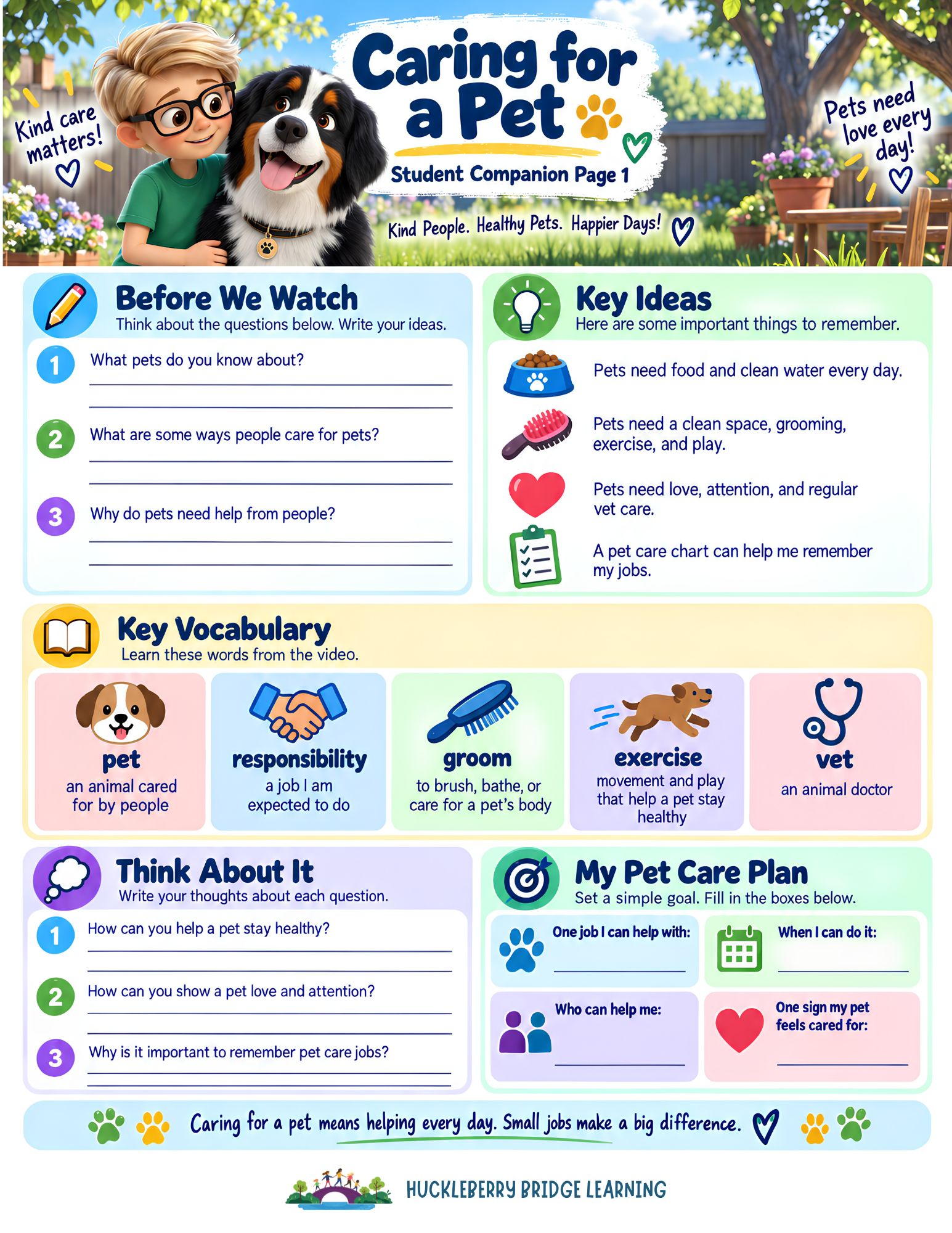
A digital guide with key concepts, visual supports, and review questions.

View Learning Guide

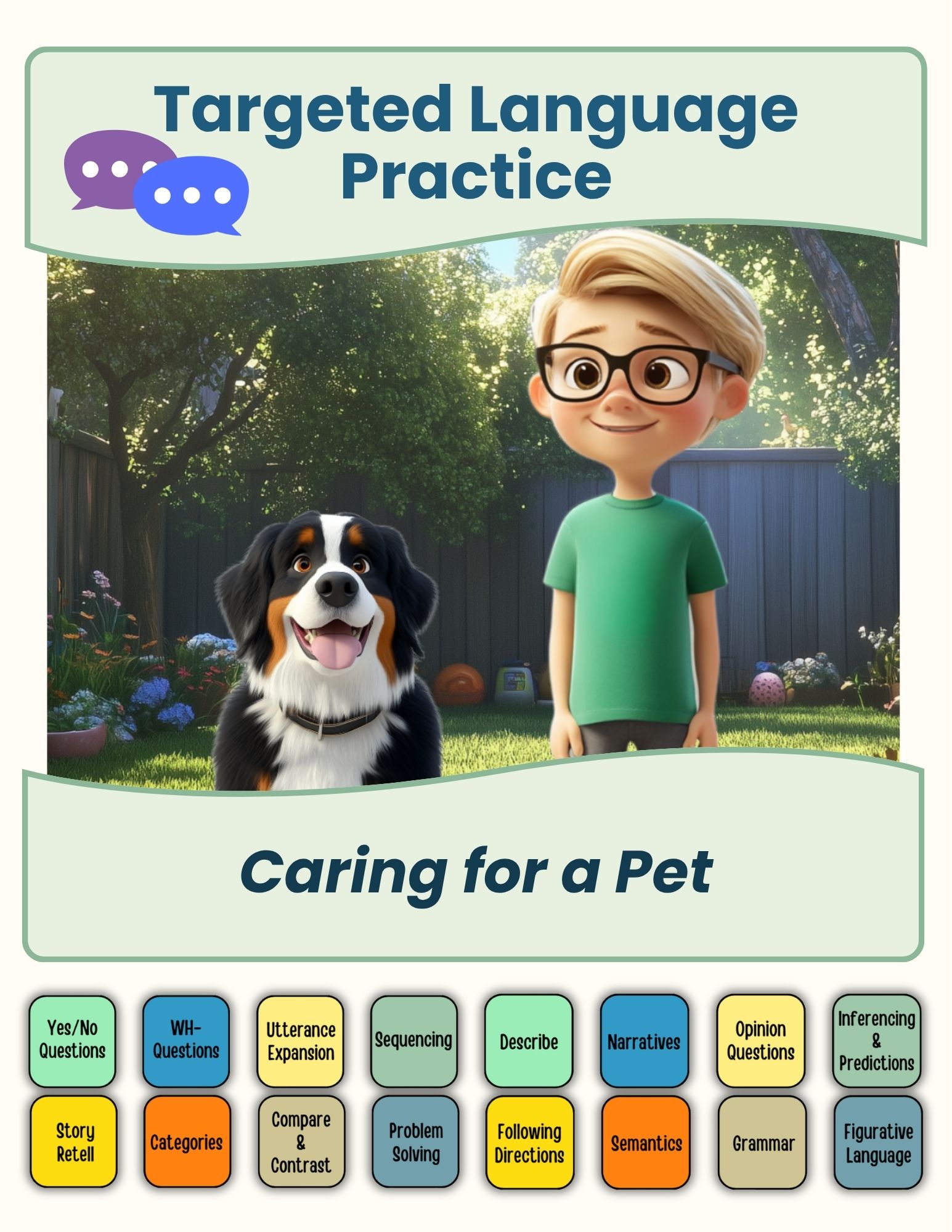
Practice language skills with targeted activities connected to the video.

Practice Language Skills

Clinician & Educator Supports

Kindergarten
CCSS.ELA-LITERACY.SL.K.1 – Participate in collaborative conversations
CCSS.ELA-LITERACY.SL.K.4 – Describe familiar people, places, and events
CCSS.ELA-LITERACY.L.K.6 – Use words and phrases acquired through conversations

Grade 1
CCSS.ELA-LITERACY.SL.1.1 – Participate in conversations with peers and adults
CCSS.ELA-LITERACY.SL.1.4 – Describe people and events with relevant details
CCSS.ELA-LITERACY.L.1.6 – Use new words to describe routines and responsibilities

Grade 2
CCSS.ELA-LITERACY.SL.2.1 – Engage in collaborative conversations
CCSS.ELA-LITERACY.SL.2.4 – Recount experiences and provide details clearly
CCSS.ELA-LITERACY.L.2.6 – Use vocabulary to describe care tasks and routines

Grade 3
CCSS.ELA-LITERACY.SL.3.1 – Participate in discussions with turn-taking
CCSS.ELA-LITERACY.SL.3.4 – Report on a topic with appropriate facts and examples
CCSS.ELA-LITERACY.L.3.6 – Use academic and domain-specific vocabulary

Grade 4
CCSS.ELA-LITERACY.SL.4.1 – Engage effectively in discussions
CCSS.ELA-LITERACY.SL.4.4 – Present ideas clearly with organized details
CCSS.ELA-LITERACY.L.4.6 – Use vocabulary related to care routines and empathy

Grade 5
CCSS.ELA-LITERACY.SL.5.1 – Participate in discussions, building on others’ ideas
CCSS.ELA-LITERACY.SL.5.4 – Report clearly and logically on responsibilities or routines
CCSS.ELA-LITERACY.L.5.6 – Use specific language to express actions and responsibilities

Grade 6
CCSS.ELA-LITERACY.SL.6.1 – Participate in collaborative discussions
CCSS.ELA-LITERACY.SL.6.4 – Present claims and ideas clearly with support
CCSS.ELA-LITERACY.L.6.6 – Use domain-specific vocabulary related to health and care

Grade 7
CCSS.ELA-LITERACY.SL.7.1 – Engage in structured discussions
CCSS.ELA-LITERACY.SL.7.4 – Present information logically and clearly with examples
CCSS.ELA-LITERACY.L.7.6 – Use vocabulary to communicate responsibility and empathy

Grade 8
CCSS.ELA-LITERACY.SL.8.1 – Initiate and participate in collaborative discussions
CCSS.ELA-LITERACY.SL.8.4 – Present ideas clearly, logically, and with organization
CCSS.ELA-LITERACY.L.8.6 – Use precise language to describe personal and social responsibility

  • The student will list at least four daily pet care tasks (e.g., feeding, grooming, play) in 4 out of 5 structured opportunities by [date].
  • The student will explain why pets need love and attention using a sentence starter or visual prompt in 3 out of 4 discussions by [date].
  • The student will role-play or demonstrate a pet care routine using a visual checklist in 4 out of 5 practice sessions by [date].
  • The student will describe how they feel when they care for a pet and how it helps the pet feel safe in 3 out of 4 conversations by [date].
  • The student will identify one example of how to care for a pet’s body (e.g., brushing, exercise, vet visits) in 4 out of 5 trials by [date].
  • The student will match pet care tools (e.g., food bowl, leash, brush) with their function in 4 out of 5 activities with 80% accuracy by [date].

Keep Learning

Explore more videos that build related skills.