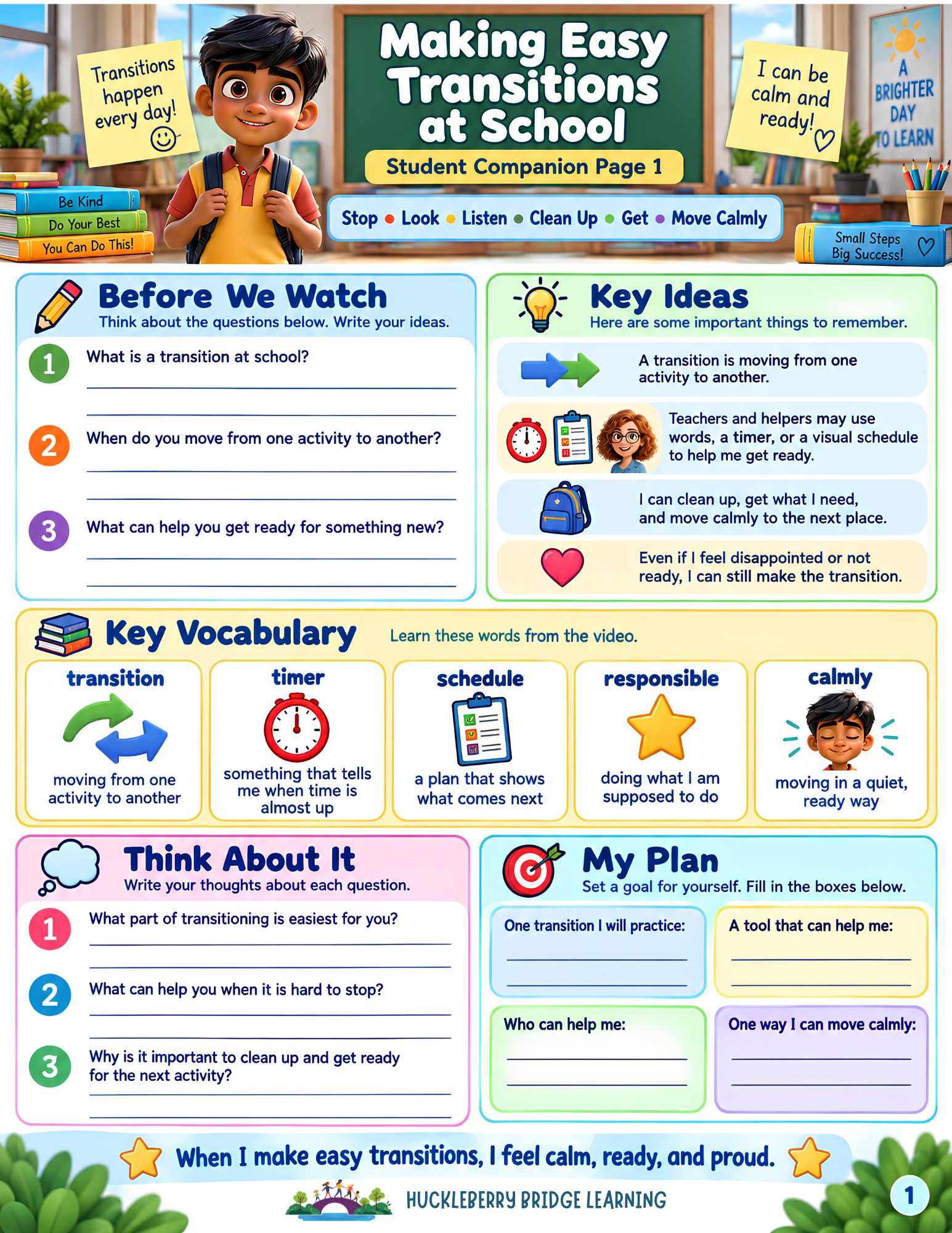
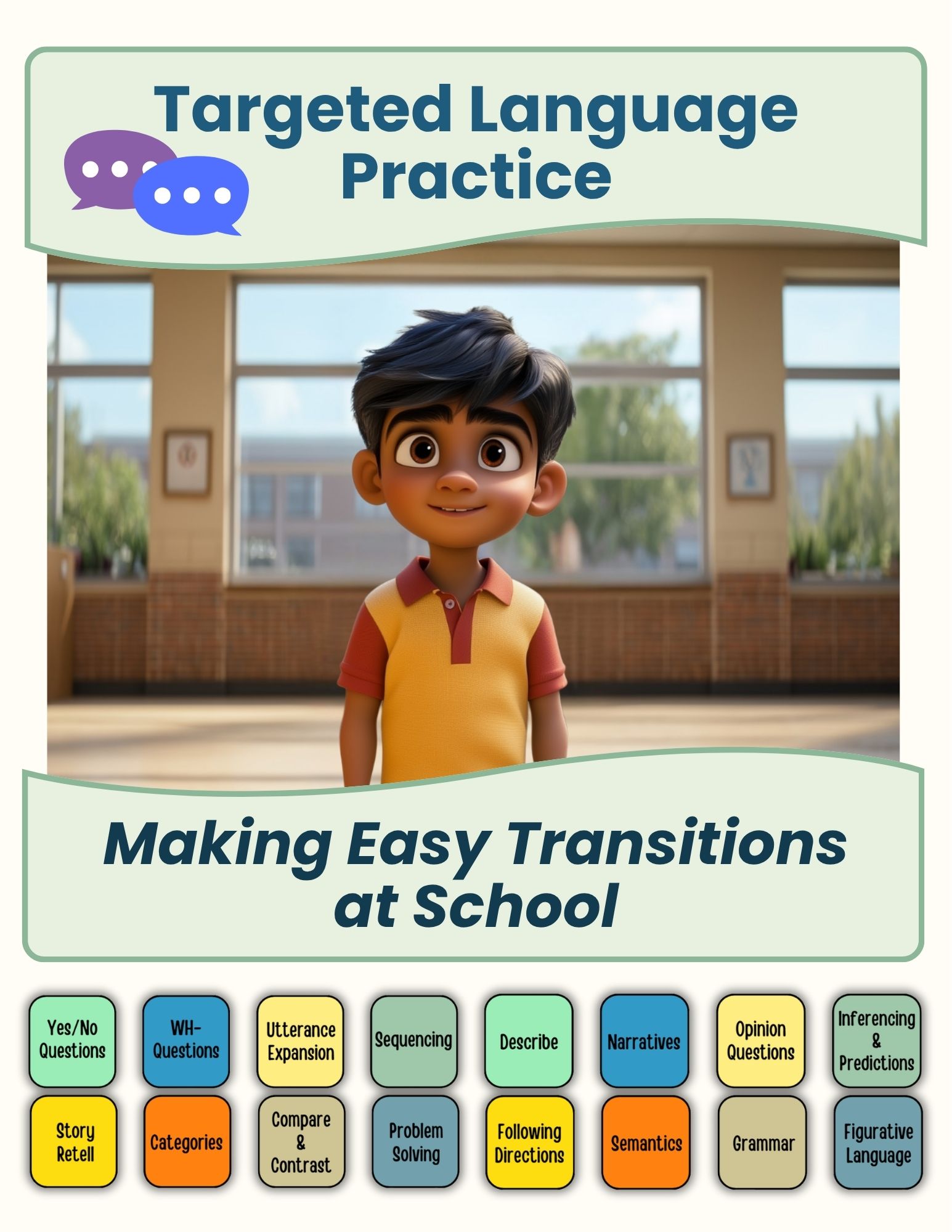
Making Easy Transitions at School

School-Related Activities

Pre-K, Elementary, Middle School

Learning Objectives
  1. Understand what a transition is and recognize common school-related transitions
  2. Recognize signals and cues that indicate it is time to transition
  3. Demonstrate expected behaviors during transitions, including stopping, cleaning up, and moving calmly
  4. Follow multi-step directions to prepare for and move to a new activity
  5. Acknowledge feelings that may occur during transitions and continue the transition appropriately
  6. Apply transition strategies to move between school activities in a calm and organized way

Kindergarten
CCSS.ELA-LITERACY.SL.K.1 – Participate in collaborative conversations
CCSS.ELA-LITERACY.SL.K.2 – Ask and answer questions about information presented orally
CCSS.ELA-LITERACY.L.K.6 – Use words and phrases acquired through conversations

Grade 1
CCSS.ELA-LITERACY.SL.1.1 – Participate in collaborative conversations
CCSS.ELA-LITERACY.SL.1.2 – Ask and answer questions about spoken and visual information
CCSS.ELA-LITERACY.L.1.6 – Use words and phrases acquired through conversations

Grade 2
CCSS.ELA-LITERACY.SL.2.1 – Engage in conversations with peers and adults
CCSS.ELA-LITERACY.SL.2.3 – Ask and answer questions to clarify comprehension
CCSS.ELA-LITERACY.L.2.6 – Use words and phrases acquired through conversations

Grade 3
CCSS.ELA-LITERACY.SL.3.1 – Engage in collaborative discussions
CCSS.ELA-LITERACY.SL.3. 3 – Ask and answer questions to stay on topic and connect comments
CCSS.ELA-LITERACY.L.3.6 – Acquire and use conversational vocabulary

Grade 4
CCSS.ELA-LITERACY.SL.4.1 – Participate in group discussions respectfully
CCSS.ELA-LITERACY.SL.4. 3 – Identify reasons and evidence a speaker provides

CCSS.ELA-LITERACY.L.4.6 – Use academic and domain-specific vocabulary

Grade 5
CCSS.ELA-LITERACY.SL.5.1 – Engage effectively in a range of collaborative discussions
CCSS.ELA-LITERACY.SL.5. 3 – Summarize points a speaker makes and explain how claims are supported
CCSS.ELA-LITERACY.L.5.6 – Use conversational, academic, and domain-specific words

Grade 6
CCSS.ELA-LITERACY.SL.6.1 – Engage effectively in collaborative discussions
CCSS.ELA-LITERACY.SL.6. 3 – Delineate a speaker’s argument and specific claims
CCSS.ELA-LITERACY.L.6.6 – Use academic and domain-specific vocabulary

Grade 7
CCSS.ELA-LITERACY.SL.7.1 – Engage in collaborative discussions with appropriate detail
CCSS.ELA-LITERACY.SL.7. 3 – Analyze a speaker’s argument and evidence
CCSS.ELA-LITERACY.L.7.6 – Accurately use grade-appropriate vocabulary

Grade 8
CCSS.ELA-LITERACY.SL.8.1 – Initiate and participate in collaborative discussions
CCSS.ELA-LITERACY.SL.8. 3 – Evaluate a speaker’s reasoning and evidence
CCSS.ELA-LITERACY.L.8.6 – Use precise words and phrases for effective communication

  • The student will stop an activity and attend to a transition signal (timer, verbal cue, or visual cue) in 4 out of 5 opportunities by [date].
  • The student will clean up materials and organize their workspace before transitioning to the next activity in 4 out of 5 opportunities with minimal prompting by [date].
  • The student will follow at least four transition steps (stop, clean up, listen, gather materials, move calmly) in 80% of observed transitions by [date].
  • The student will transition calmly to the next activity within two minutes of a transition cue in 4 out of 5 opportunities by [date].
  • The student will identify or acknowledge a feeling related to transitioning (using words, visuals, or AAC) and continue the transition in 3 out of 4 opportunities by [date].

Related Companion Activity