Wearing My Glasses

About This Video

Wearing My Glasses is a supportive life skills video that helps children understand why wearing glasses can be important for seeing clearly and participating in daily activities. This video teaches learners to put on their glasses when needed, keep them safe, clean them carefully, and ask an adult for help if their glasses feel uncomfortable, get dirty, or are misplaced.

Learning Objectives

After watching this video, learners will:

  1. Understand that glasses help some people see more clearly
  2. Recognize that wearing glasses may feel new or different at first
  3. Identify parts of glasses and where they rest on the face
  4. Demonstrate appropriate behaviors for wearing glasses safely
  5. Explain simple ways to care for glasses, including using gentle hands and storing them safely
  6. Recognize that many children wear glasses and that it is a normal way to help the body

Resources for This Video

Use these resources to extend learning and build communication skills.

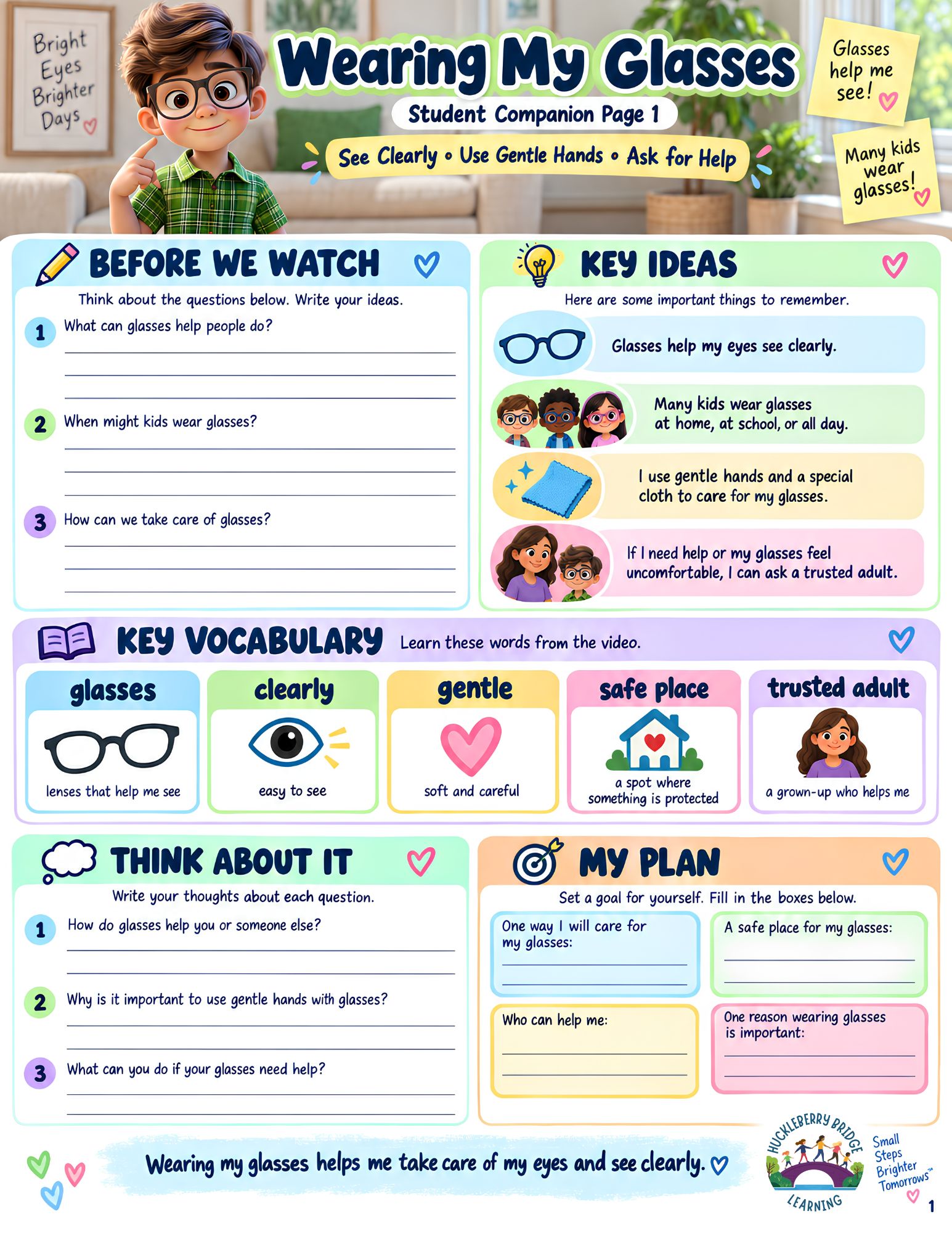
A digital guide with key concepts, visual supports, and review questions.

View Learning Guide

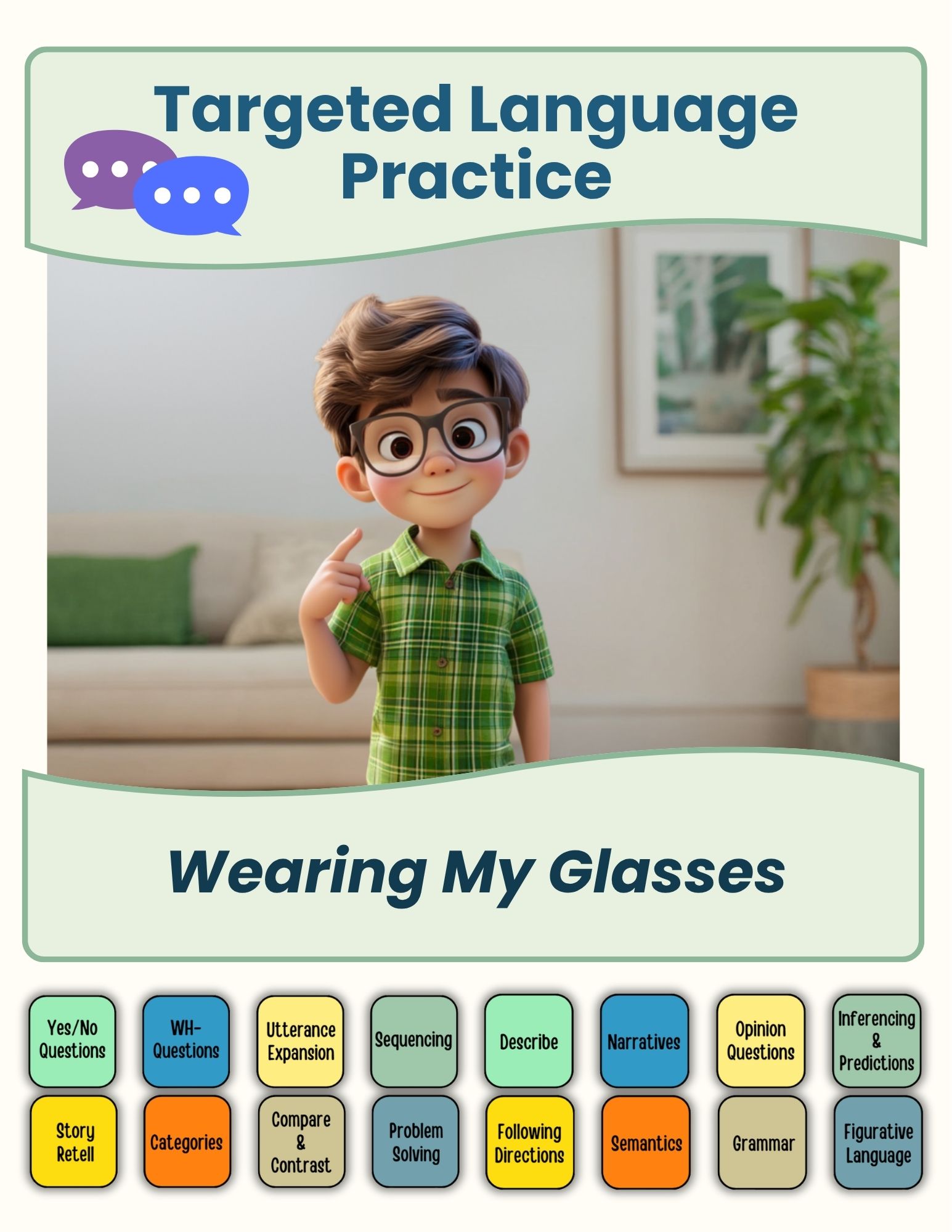
Practice language skills with targeted activities connected to the video.

Practice Language Skills

Clinician & Educator Supports

Kindergarten
CCSS.ELA-LITERACY.SL.K.1 – Participate in collaborative conversations
CCSS.ELA-LITERACY.SL.K.2 – Ask and answer questions about key details in information presented orally
CCSS.ELA-LITERACY.L.K.6 – Use words and phrases acquired through conversations and listening

Grade 1
CCSS.ELA-LITERACY.SL.1.1 – Participate in collaborative conversations with peers and adults
CCSS.ELA-LITERACY.SL.1.2 – Ask and answer questions about key details in information presented orally or through other media
CCSS.ELA-LITERACY.L.1.6 – Use words and phrases acquired through conversations and reading

Grade 2
CCSS.ELA-LITERACY.SL.2.1 – Participate in collaborative conversations with diverse partners
CCSS.ELA-LITERACY.SL.2.2 – Recount or describe key ideas from information presented orally or through other media
CCSS.ELA-LITERACY.L.2.6 – Use words and phrases acquired through conversations and reading

Grade 3
CCSS.ELA-LITERACY.SL.3.1 – Engage effectively in collaborative discussions
CCSS.ELA-LITERACY.SL.3.2 – Determine the main ideas and supporting details of information presented in diverse media

Grade 4
CCSS.ELA-LITERACY.SL.4.1 – Engage effectively in a range of collaborative discussions with diverse partners on grade 4 topics and texts.
CCSS.ELA-LITERACY.SL.4.2 – Paraphrase portions of information presented in diverse media and formats, including visually and orally.

Grade 5
CCSS.ELA-LITERACY.SL.5.1 – Engage effectively in a range of collaborative discussions with diverse partners on grade 5 topics and texts.
CCSS.ELA-LITERACY.SL.5.2 – Summarize information presented in diverse media and formats, including visually and orally.

Grade 6
CCSS.ELA-LITERACY.SL.6.1 – Engage effectively in a range of collaborative discussions with diverse partners on grade 6 topics and texts.
CCSS.ELA-LITERACY.SL.6.2 – Interpret information presented in diverse media and formats and explain how it contributes to understanding.

Grade 7
CCSS.ELA-LITERACY.SL.7.1 – Engage effectively in a range of collaborative discussions with diverse partners on grade 7 topics and texts.
CCSS.ELA-LITERACY.SL.7.2 – Analyze the main ideas and supporting details presented in diverse media and formats.

Grade 8
CCSS.ELA-LITERACY.SL.8.1 – Engage effectively in a range of collaborative discussions with diverse partners on grade 8 topics and texts.
CCSS.ELA-LITERACY.SL.8.2 – Analyze the purpose of information presented in diverse media and formats and evaluate its clarity and accuracy.

  • Self-Awareness / Body Awareness
    Given a life skills video and guided discussion, the student will explain the purpose of glasses (helping eyes see clearly) in 4 out of 5 opportunities across 3 sessions as measured by clinician data collection by [date].
  • Life Skills / Self-Care
    Given visual supports and modeling, the student will identify or demonstrate two appropriate ways to care for glasses (e.g., using gentle hands, wiping with a cloth, placing in a safe place) in 4 out of 5 opportunities across 3 sessions by [date].
  • Receptive Language
    After viewing the life skills video, the student will answer WH-questions related to the story (e.g., who wears glasses, why glasses are used, how to care for glasses) with 80% accuracy across 3 consecutive sessions by [date].
  • Expressive Language
    Given picture prompts or discussion, the student will verbally describe or label at least two ways glasses help people in 4 out of 5 opportunities across 3 sessions by [date].
  • Social Understanding / Self-Acceptance
    After viewing the story, the student will state that wearing glasses is normal or helpful in 4 out of 5 structured opportunities across 3 sessions by [date].

Keep Learning

Explore more videos that build related skills.