How to Help Kids Start a Conversation with Confidence: Social Skills Strategies That Work
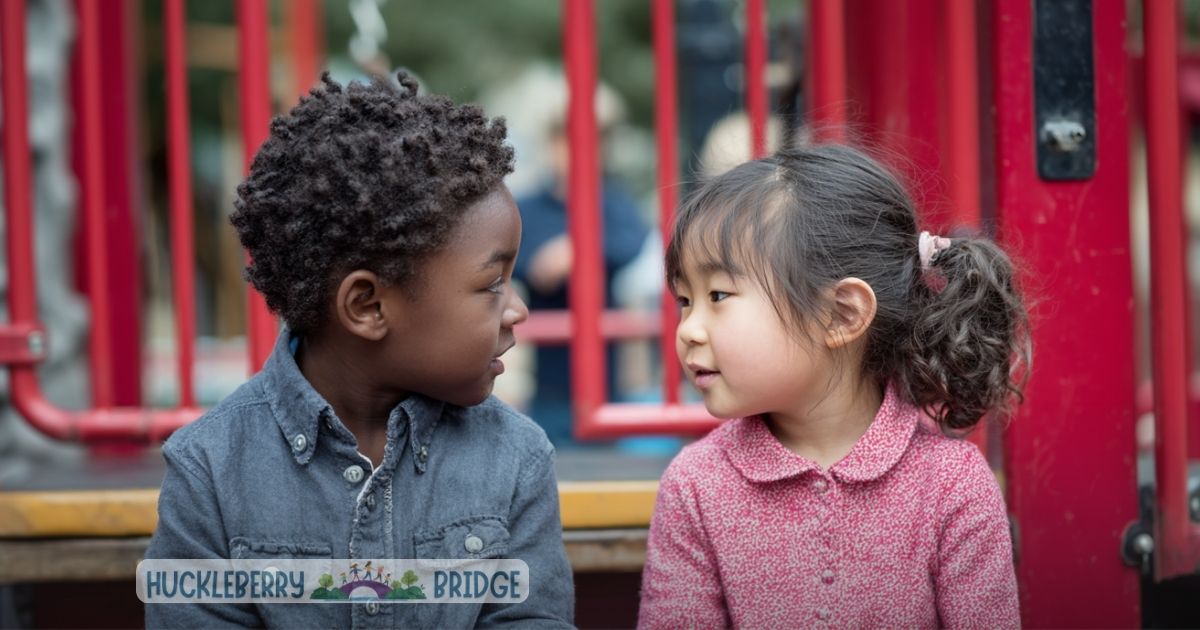
How to help kids start a conversation is a question many parents, teachers, and therapists ask when supporting children who struggle with social confidence, communication, or peer interactions. Starting a conversation requires more than knowing what to say—it involves timing, social awareness, emotional regulation, and practice.
For many children, especially those with autism, ADHD, anxiety, or pragmatic language difficulties, conversation initiation does not develop intuitively. Instead, it must be explicitly taught, modeled, and practiced. This is where visual supports and life skills videos can make a meaningful difference.
At Huckleberry Bridge Learning, our Starting a Conversation life skills lesson was created to break this complex skill into clear, manageable steps that children can understand and apply across settings. Check it out here: https://huckleberrybridge.com/video/starting-a-conversation/
Why Starting a Conversation Is an Important Social Skill for Kids
Initiating a conversation is a foundational social communication skill. It allows children to:
-
Make and maintain friendships
-
Join group activities
-
Ask for help or clarification
-
Participate in classroom discussions
-
Build confidence and independence
Research shows that strong social communication skills are associated with improved peer relationships, emotional well-being, and academic engagement (Rose-Krasnor, 1997).
Why Some Children Struggle to Start Conversations
Understanding why a child struggles is key to knowing how to help kids start a conversation effectively.
Difficulty Knowing What to Say
Some children freeze because they don’t know how to begin. They may wait for others to approach them or rely on repeated phrases.
Trouble Reading Social Cues
Recognizing whether someone is available or interested requires social awareness that many children are still developing (Guralnick, 2011).
Anxiety or Fear of Rejection
Social interactions can feel risky, especially for children who have experienced negative peer responses.
Executive Functioning Challenges
Conversation initiation involves sequencing steps (greeting → question → response). Children with executive functioning difficulties may need explicit guidance.
Language or Pragmatic Communication Difficulties
Children with pragmatic language challenges often need support forming questions, maintaining topics, and responding appropriately (Adams et al., 2012).
How to Help Kids Start a Conversation Using Life Skills Lessons
Life skills lessons are an intervention used widely in speech therapy and special education. They are effective because they:
-
Break abstract social skills into concrete steps
-
Use predictable, child-friendly language
-
Reduce anxiety by clarifying expectations
-
Model appropriate social behavior
-
Provide scripts children can rehearse and generalize
Our Starting a Conversation life skills video explicitly teaches children how to:
-
Get someone’s attention
-
Use a friendly greeting
-
Ask a simple, relevant question
-
Wait and listen for a response
-
Continue or end a conversation appropriately
This structured approach helps children internalize the process and apply it in real-life situations.
When combined with our companion activities, the video provides explicit instruction, visual reinforcement, and opportunities for repeated practice—key components for social skill development. https://huckleberrybridge.com/companion-activity/starting-a-conversation/
Step-by-Step Strategies to Teach Kids How to Start a Conversation
Below are practical strategies that align directly with the life skills video and support how to help kids start a conversation with confidence.
1. Start With a Friendly Greeting
Teach simple greetings such as “Hi,” “Hello,” or “Hey.”
2. Check If the Person Is Ready
Children learn to look for cues like eye contact, body orientation, or a pause in activity (Guralnick, 2011).
3. Ask a Simple Question
Effective conversation starters are short and context-based:
-
“Can I play with you?”
-
“What are you working on?”
-
“Do you want to sit together?”
4. Listen and Respond
Conversation is reciprocal. Children practice waiting, responding, and showing interest.
5. Practice Through Role-Play
Research shows that rehearsal and role-play improve generalization of social skills (Bellini et al., 2007).
Using the “Starting a Conversation” Life Skills Video at Home, School, and in Therapy
At Home
-
Watch the video before playdates
-
Practice greetings with family members
-
Use conversation starters at meals
In the Classroom
-
Show the video before recess or centers
-
Pair with visual cue cards
-
Model conversation starters during morning meetings
In Therapy
-
Pause the video to discuss social cues
-
Practice with turn-taking games
-
Combine with WH-question and pragmatic language goals
Consistent modeling across environments helps children generalize skills and build confidence.
Helping Kids Build Confidence in Social Communication
Learning how to help kids start a conversation takes time, repetition, and encouragement. With explicit instruction, visual supports, and guided practice, children can develop the confidence to initiate conversations independently.
The Starting a Conversation life skills lesson gives children the structure, language, and predictability they need to connect with others successfully.
Learn more at https://huckleberrybridge.com/video/starting-a-conversation/
References
Adams, C., Gaile, J., Freed, J., & Lockton, E. (2012). Integrating language, pragmatics, and social intervention in children with communication disorders. International Journal of Language & Communication Disorders, 47(4), 445–462.
https://onlinelibrary.wiley.com/doi/10.1111/j.1460-6984.2012.00149.x
Bellini, S., Peters, J. K., Benner, L., & Hopf, A. (2007). A meta-analysis of school-based social skills interventions for children with autism spectrum disorders. Remedial and Special Education, 28(3), 153–162.
https://journals.sagepub.com/doi/10.1177/07419325070280030401
Guralnick, M. J. (2011). Why early intervention works: A systems perspective. Infants & Young Children, 24(1), 6–28.
https://journals.lww.com/iycjournal/fulltext/2011/01000/why_early_intervention_works__a_systems.2.aspx
Rose-Krasnor, L. (1997). The nature of social competence: A theoretical review. Social Development, 6(1), 111–135.
https://onlinelibrary.wiley.com/doi/10.1111/j.1467-9507.1997.tb00097.x