Starting a Conversation

Social Interactions

Pre-K, Elementary, Middle School, High School

Learning Objectives
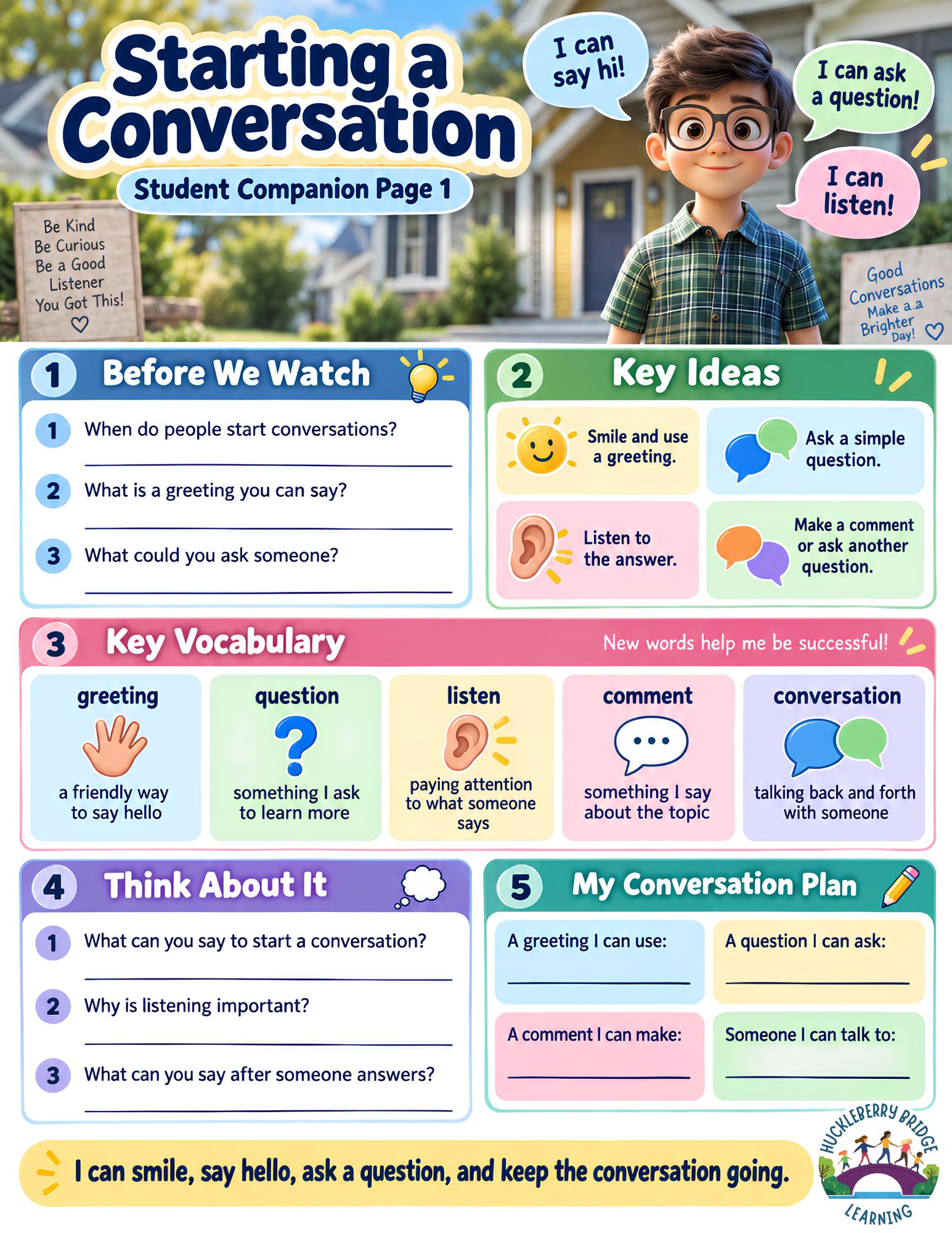
  1. Understand why starting a conversation can feel challenging
  2. Learn and practice step-by-step strategies to start a conversation
  3. Use greetings like “hi” or “good morning” to show friendliness
  4. Ask a simple question to express interest in the other person
  5. Practice listening attentively to the other person’s response
  6. Learn how to keep the conversation going by commenting or asking follow-up questions
  7. Build confidence and comfort in social interactions through practice

Kindergarten
CCSS.ELA-LITERACY.SL.K.1 – Participate in collaborative conversations
CCSS.ELA-LITERACY.SL.K.6 – Speak audibly and express ideas clearly
CCSS.ELA-LITERACY.L.K.6 – Use words and phrases acquired through conversations

Grade 1
CCSS.ELA-LITERACY.SL.1.1 – Participate in collaborative conversations
CCSS.ELA-LITERACY.SL.1.4 – Describe events or experiences with relevant details
CCSS.ELA-LITERACY.L.1.6 – Use language to express ideas and feelings

Grade 2
CCSS.ELA-LITERACY.SL.2.1 – Engage in conversations with peers and adults
CCSS.ELA-LITERACY.SL.2.3 – Ask and answer questions to clarify understanding
CCSS.ELA-LITERACY.L.2.6 – Use acquired vocabulary to express and respond socially

Grade 3
CCSS.ELA-LITERACY.SL.3.1 – Engage in collaborative discussions
CCSS.ELA-LITERACY.SL.3.3 – Ask and answer questions to understand and engage with others
CCSS.ELA-LITERACY.L.3.6 – Use vocabulary to express thoughts, questions, and social skills

Grade 4
CCSS.ELA-LITERACY.SL.4.1 – Participate effectively in group discussions
CCSS.ELA-LITERACY.SL.4.3 – Identify reasons and evidence a speaker provides
CCSS.ELA-LITERACY.L.4.6 – Use precise vocabulary to interact and respond to others

Grade 5
CCSS.ELA-LITERACY.SL.5.1 – Engage in respectful discussions, building on others’ ideas
CCSS.ELA-LITERACY.SL.5.3 – Summarize points a speaker makes and explain responses
CCSS.ELA-LITERACY.L.5.6 – Use academic and interpersonal vocabulary in social contexts

Grade 6
CCSS.ELA-LITERACY.SL.6.1 – Participate in collaborative discussions
CCSS.ELA-LITERACY.SL.6.3 – Delineate a speaker’s purpose and tone
CCSS.ELA-LITERACY.L.6.6 – Use vocabulary appropriate for social and academic discussions

Grade 7
CCSS.ELA-LITERACY.SL.7.1 – Engage in collaborative discussions
CCSS.ELA-LITERACY.SL.7.4 – Present ideas clearly and respond appropriately in conversation
CCSS.ELA-LITERACY.L.7.6 – Use vocabulary to express social awareness and purpose

Grade 8
CCSS.ELA-LITERACY.SL.8.1 – Initiate and participate in collaborative conversations
CCSS.ELA-LITERACY.SL.8.3 – Evaluate how speakers express their ideas and respond
CCSS.ELA-LITERACY.L.8.6 – Use precise language in a variety of social interactions

  • The student will demonstrate the steps for starting a conversation (smile, greet, ask a question, respond) in 4 out of 5 role-play trials by [date].
  • The student will use an appropriate greeting (e.g., “hi,” “hello”) to begin an interaction in 4 out of 5 structured opportunities by [date].
  • The student will ask a simple topic-related question to initiate conversation in 3 out of 4 social scenarios by [date].
  • The student will respond with a related comment or follow-up question after listening to a peer’s response in 4 out of 5 guided activities by [date].
  • The student will describe the steps to starting a conversation using a visual or verbal prompt in 3 out of 4 discussions by [date].
  • The student will express increased confidence or comfort in starting conversations through verbal reflection or sentence completion in 3 out of 4 sessions by [date].

Related Companion Activity