Ending a Conversation

Social Interactions

Pre-K, Elementary, Middle School

Learning Objectives
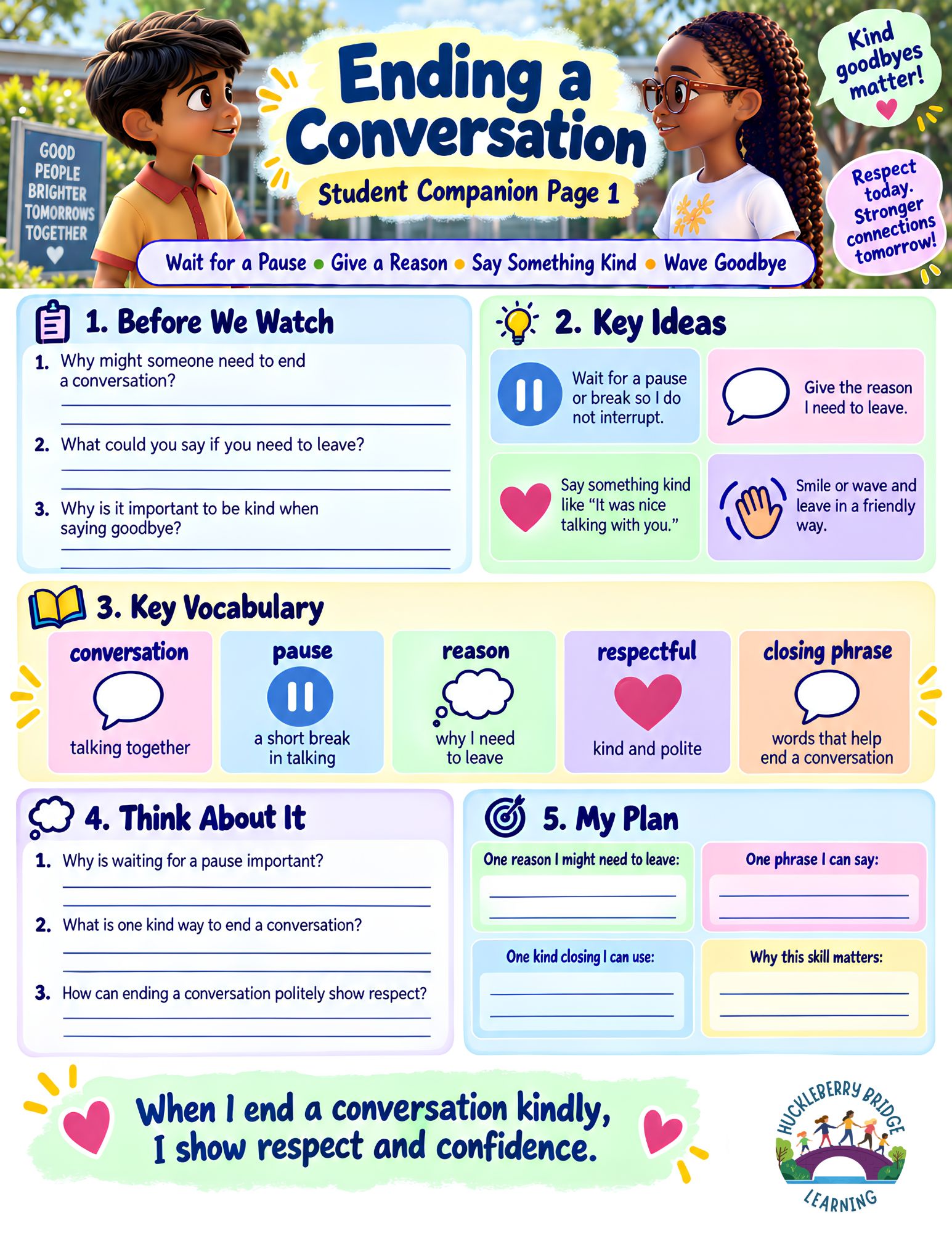
  1. Identify reasons why a conversation might need to end
  2. Recognize appropriate times to end a conversation, such as during a pause
  3. Demonstrate how to give a brief and respectful reason for ending a conversation
  4. Use kind and polite phrases to close a conversation
  5. Show appropriate nonverbal cues when ending a conversation, like smiling or waving
  6. Practice respectful turn-taking by waiting for a natural break in the conversation
  7. Understand how ending a conversation politely shows respect and social awareness
  8. Build confidence in initiating and completing social interactions

Kindergarten
CCSS.ELA-LITERACY.SL.K.1 – Participate in collaborative conversations with diverse partners about kindergarten topics and texts with peers and adults in small and larger groups
CCSS.ELA-LITERACY.SL.K.6 – Speak audibly and express thoughts, feelings, and ideas clearly

Grade 1
CCSS.ELA-LITERACY.SL.1.1 – Participate in collaborative conversations with diverse partners about grade 1 topics and texts with peers and adults in small and larger groups
CCSS.ELA-LITERACY.SL.1.6 – Produce complete sentences when appropriate to task and situation

Grade 2
CCSS.ELA-LITERACY.SL.2.1 – Participate in collaborative conversations with diverse partners about grade 2 topics and texts with peers and adults in small and larger groups
CCSS.ELA-LITERACY.SL.2.6 – Produce complete sentences when appropriate to task and situation

Grade 3
CCSS.ELA-LITERACY.SL.3.1 – Engage effectively in a range of collaborative discussions with diverse partners on grade 3 topics and texts
CCSS.ELA-LITERACY.SL.3.6 – Speak in complete sentences when appropriate to task and situation in order to provide requested detail or clarification

Grade 4
CCSS.ELA-LITERACY.SL.4.1 – Engage effectively in a range of collaborative discussions with diverse partners on grade 4 topics and texts
CCSS.ELA-LITERACY.SL.4.6 – Differentiate between contexts that call for formal English and situations where informal discourse is appropriate

Grade 5
CCSS.ELA-LITERACY.SL.5.1 – Engage effectively in a range of collaborative discussions with diverse partners on grade 5 topics and texts
CCSS.ELA-LITERACY.SL.5.6 – Adapt speech to a variety of contexts and tasks, using formal English when appropriate

Grade 6
CCSS.ELA-LITERACY.SL.6.1 – Engage effectively in a range of collaborative discussions with diverse partners on grade 6 topics, texts, and issues
CCSS.ELA-LITERACY.SL.6.6 – Adapt speech to a variety of contexts and tasks, demonstrating command of formal English when appropriate

Grade 7
CCSS.ELA-LITERACY.SL.7.1 – Engage effectively in a range of collaborative discussions with diverse partners on grade 7 topics, texts, and issues
CCSS.ELA-LITERACY.SL.7.6 – Adapt speech to a variety of contexts and tasks, demonstrating command of formal English when appropriate

Grade 8
CCSS.ELA-LITERACY.SL.8.1 – Engage effectively in a range of collaborative discussions with diverse partners on grade 8 topics, texts, and issues
CCSS.ELA-LITERACY.SL.8.6 – Adapt speech to a variety of contexts and tasks, demonstrating command of formal English when appropriate

  • The student will identify at least three appropriate reasons for ending a conversation in 4 out of 5 opportunities by [date].
  • The student will wait for a pause or natural break in conversation before responding in 4 out of 5 role-play scenarios by [date].
  • The student will state a brief and appropriate reason for ending a conversation in 3 out of 4 role-play situations by [date].
  • The student will use a polite closing phrase (e.g., “It was nice talking with you”) to end a conversation appropriately in 4 out of 5 opportunities by [date].
  • The student will demonstrate a nonverbal cue such as a smile or wave when ending a conversation in 4 out of 5 role-play interactions by [date].
  • The student will participate in a structured conversation and independently follow all four steps to end it appropriately in 3 out of 4 trials by [date].
  • The student will describe the steps to politely end a conversation with 80% accuracy during structured practice by [date].
  • The student will recognize when another person is ready to end a conversation in 4 out of 5 observations or structured tasks by [date].

Related Companion Activity