Being A Good Listener

Social Interactions

Pre-K, Elementary, Middle School, High School

Learning Objectives
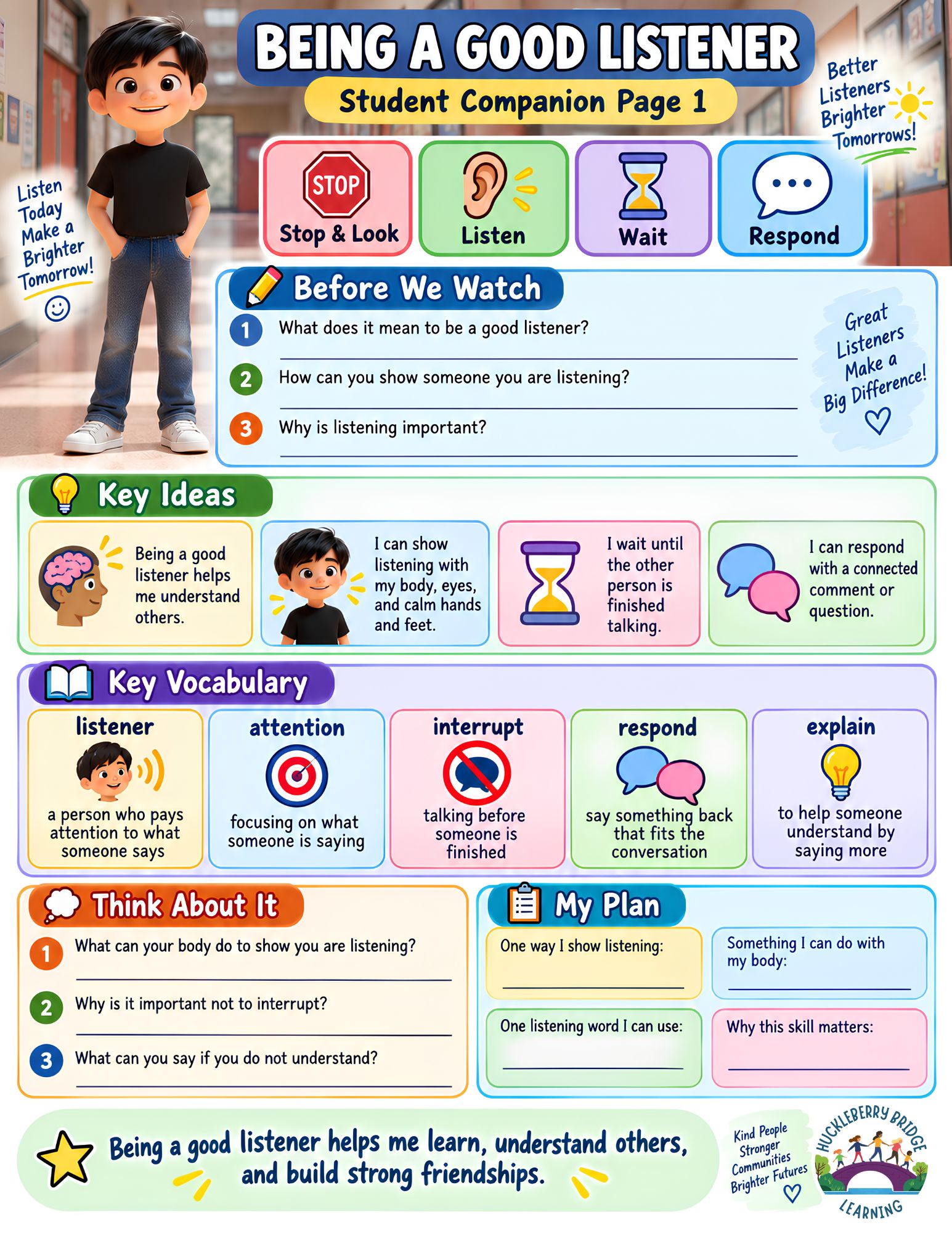
  1. Understand what it means to be a good listener
  2. Learn the importance of listening for understanding and kindness
  3. Recognize behaviors that show someone is listening (e.g., calm body, eye contact)
  4. Demonstrate whole-body listening skills
  5. Practice responding with short phrases and questions that show engagement
  6. Understand how to wait and not interrupt while someone is speaking
  7. Recognize how good listening builds friendships and helps others feel respected

Kindergarten
CCSS.ELA-LITERACY.SL.K.1 – Participate in collaborative conversations
CCSS.ELA-LITERACY.SL.K.2 – Confirm understanding by asking and answering questions
CCSS.ELA-LITERACY.L.K.6 – Use words and phrases acquired through conversations

Grade 1
CCSS.ELA-LITERACY.SL.1.1 – Participate in collaborative conversations
CCSS.ELA-LITERACY.SL.1.2 – Ask and answer questions about spoken information
CCSS.ELA-LITERACY.L.1.6 – Use words and phrases acquired through conversation

Grade 2
CCSS.ELA-LITERACY.SL.2.1 – Participate in collaborative conversations with peers and adults
CCSS.ELA-LITERACY.SL.2.2 – Recount or describe key ideas from spoken information
CCSS.ELA-LITERACY.L.2.6 – Use acquired words and phrases to communicate understanding

Grade 3
CCSS.ELA-LITERACY.SL.3.1 – Engage in collaborative discussions
CCSS.ELA-LITERACY.SL.3.2 – Determine the main ideas and details from spoken content
CCSS.ELA-LITERACY.L.3.6 – Use conversational and academic vocabulary appropriately

Grade 4
CCSS.ELA-LITERACY.SL.4.1 – Engage effectively in discussions
CCSS.ELA-LITERACY.SL.4.2 – Paraphrase spoken material
CCSS.ELA-LITERACY.L.4.6 – Acquire and use grade-appropriate vocabulary

Grade 5
CCSS.ELA-LITERACY.SL.5.1 – Participate in discussions, building on others’ ideas
CCSS.ELA-LITERACY.SL.5.2 – Summarize information from diverse media and formats
CCSS.ELA-LITERACY.L.5.6 – Use academic vocabulary to express understanding

Grade 6
CCSS.ELA-LITERACY.SL.6.1 – Participate in collaborative discussions
CCSS.ELA-LITERACY.SL.6.2 – Interpret information from spoken and multimedia formats
CCSS.ELA-LITERACY.L.6.6 – Use general academic and domain-specific vocabulary

Grade 7
CCSS.ELA-LITERACY.SL.7.1 – Engage in collaborative discussions
CCSS.ELA-LITERACY.SL.7.2 – Analyze the ideas and emotional tone in spoken presentations
CCSS.ELA-LITERACY.L.7.6 – Use precise vocabulary to discuss and reflect on listening skills

Grade 8
CCSS.ELA-LITERACY.SL.8.1 – Initiate and participate in collaborative discussions
CCSS.ELA-LITERACY.SL.8.2 – Evaluate the effectiveness of a speaker’s message
CCSS.ELA-LITERACY.L.8.6 – Use academic and interpersonal vocabulary in context

  • The student will demonstrate whole-body listening (calm body, facing speaker, visual attention) during structured practice in 4 out of 5 opportunities by [date].
  • The student will respond to a speaker using one short listening phrase (e.g., “okay,” “I see”) in 4 out of 5 trials during conversation activities by [date].
  • The student will wait to respond until a speaker has finished talking in 4 out of 5 structured conversations by [date].
  • The student will answer a question about what someone said, showing understanding, in 4 out of 5 opportunities with 80% accuracy by [date].
  • The student will ask one clarifying or follow-up question after listening to a peer or adult in 3 out of 4 guided discussions by [date].
  • The student will identify two ways being a good listener helps relationships during discussion or journaling tasks in 3 out of 4 sessions by [date].

Related Companion Activity