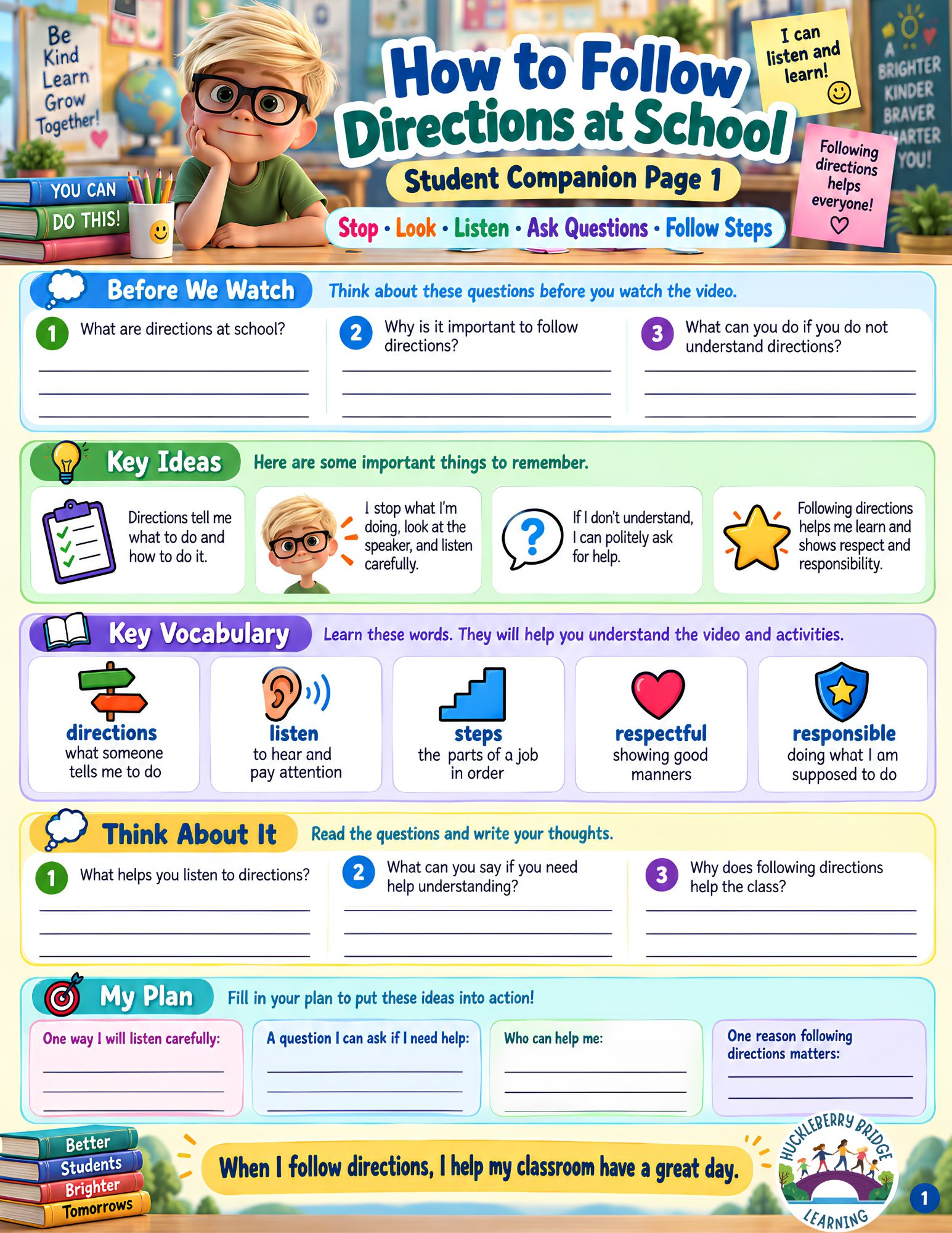
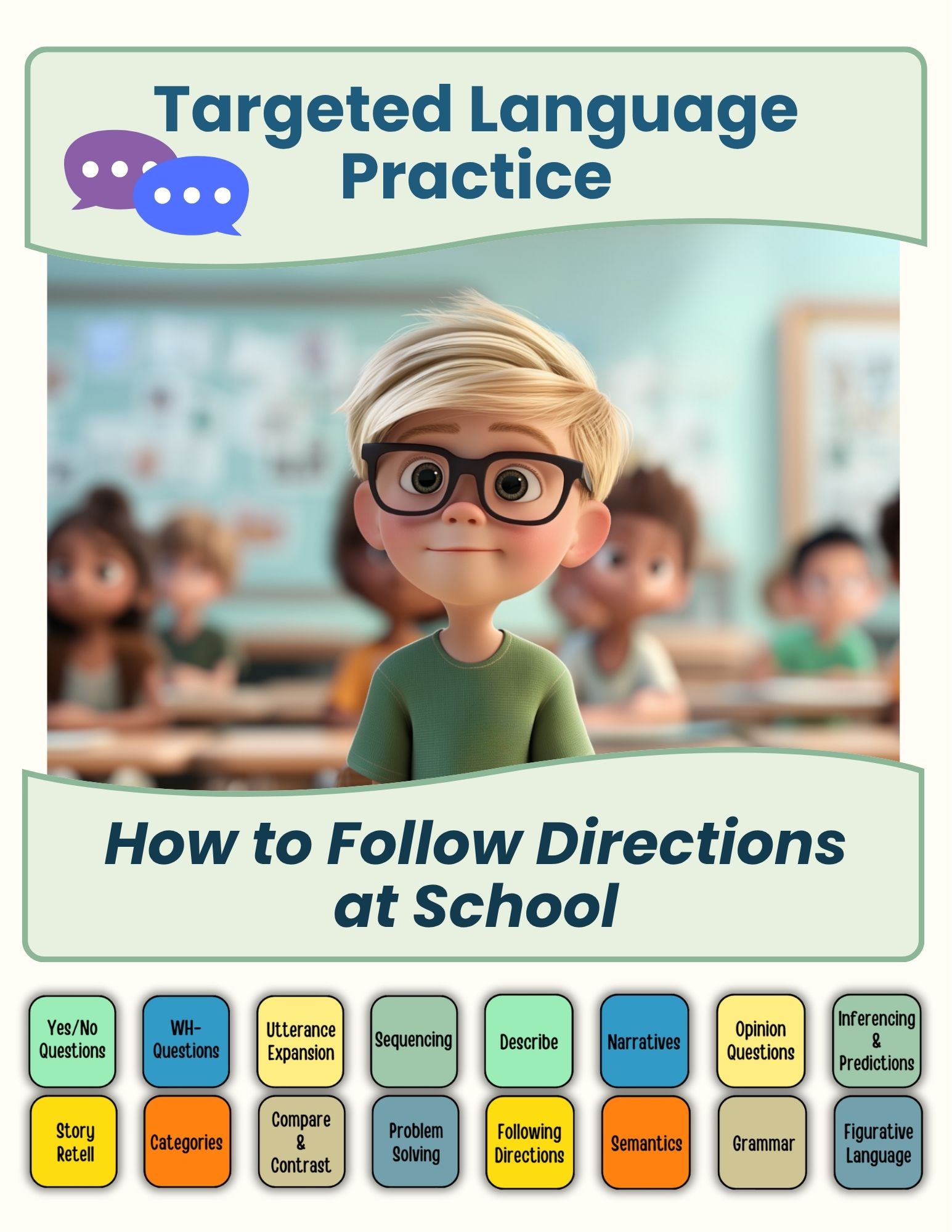
How to Follow Directions at School

About This Video

How to Follow Directions at School is a supportive life skills video that helps children learn how to listen to and follow directions during the school day. This video teaches learners to look toward the speaker, listen carefully, think about the steps, ask for help or clarification when needed, and begin the task so they can participate more successfully in classroom routines and activities.

Learning Objectives

After watching this video, learners will:

  1. Students will identify and demonstrate strategies for listening to and remembering directions.
  2. Students will recognize how following directions contributes to a safe and productive classroom.
  3. Students will use polite phrases to request clarification when needed.
  4. Students will model respectful body language while listening to instructions.
  5. Students will practice following single-step and multi-step directions in structured activities.

Resources for This Video

Use these resources to extend learning and build communication skills.

A digital guide with key concepts, visual supports, and review questions.

View Learning Guide

Practice language skills with targeted activities connected to the video.

Practice Language Skills

Clinician & Educator Supports

Kindergarten
CCSS.ELA-LITERACY.SL.K.1 – Participate in collaborative conversations
CCSS.ELA-LITERACY.SL.K.2 – Ask and answer questions about information presented orally
CCSS.ELA-LITERACY.L.K.6 – Use words and phrases acquired through conversations

Grade 1
CCSS.ELA-LITERACY.SL.1.1 – Participate in collaborative conversations
CCSS.ELA-LITERACY.SL.1.2 – Ask and answer questions about spoken and visual information
CCSS.ELA-LITERACY.L.1.6 – Use acquired vocabulary to describe actions and routines

Grade 2
CCSS.ELA-LITERACY.SL.2.1 – Engage in conversations with peers and adults
CCSS.ELA-LITERACY.SL.2.2 – Recount or describe key ideas from multimedia or spoken lessons
CCSS.ELA-LITERACY.L.2.6 – Use vocabulary for classroom routines in discussions

Grade 3
CCSS.ELA-LITERACY.SL.3.1 – Engage in collaborative discussions
CCSS.ELA-LITERACY.SL.3.2 – Determine the main idea and supporting details from spoken information
CCSS.ELA-LITERACY.L.3.6 – Use precise vocabulary to describe classroom participation

Grade 4
CCSS.ELA-LITERACY.SL.4.1 – Participate in group discussions respectfully
CCSS.ELA-LITERACY.SL.4.2 – Paraphrase key information from multimedia or oral presentations
CCSS.ELA-LITERACY.L.4.6 – Use academic and behavioral vocabulary to express understanding

Grade 5
CCSS.ELA-LITERACY.SL.5.1 – Participate in structured discussions on classroom-related topics
CCSS.ELA-LITERACY.SL.5.2 – Summarize information from spoken or media content
CCSS.ELA-LITERACY.L.5.6 – Use relevant vocabulary when discussing participation and attention

Grade 6
CCSS.ELA-LITERACY.SL.6.1 – Engage effectively in collaborative discussions
CCSS.ELA-LITERACY.SL.6.2 – Interpret and evaluate spoken information for key messages
CCSS.ELA-LITERACY.L.6.6 – Use vocabulary to communicate ideas about responsibility and focus

Grade 7
CCSS.ELA-LITERACY.SL.7.1 – Engage in collaborative discussions with appropriate detail
CCSS.ELA-LITERACY.SL.7.2 – Analyze key points and tone in spoken material about classroom participation
CCSS.ELA-LITERACY.L.7.6 – Use precise vocabulary to discuss responsibility, attention, and cooperation

Grade 8
CCSS.ELA-LITERACY.SL.8.1 – Initiate and participate in collaborative discussions
CCSS.ELA-LITERACY.SL.8.2 – Evaluate purpose and clarity in messages about participation and focus
CCSS.ELA-LITERACY.L.8.6 – Use academic and social vocabulary to express understanding of listening and participation

  • The student will follow single-step directions in 4 of 5 opportunities with 80% accuracy by [date].
  • The student will follow multi-step directions in 4 of 5 opportunities with 80% accuracy by [date].
  • The student will use polite phrases to request clarification of directions in 4 of 5 structured opportunities by [date].
  • The student will demonstrate attentive listening behaviors (e.g., eye contact, calm body, facing speaker) in 80% of observed opportunities by [date].
  • The student will use visualizing or repetition strategies to remember directions in 4 of 5 trials by [date].

Keep Learning

Explore more videos that build related skills.