Waking Up On Time

Daily Routines

Elementary, Middle School, High School

Learning Objectives
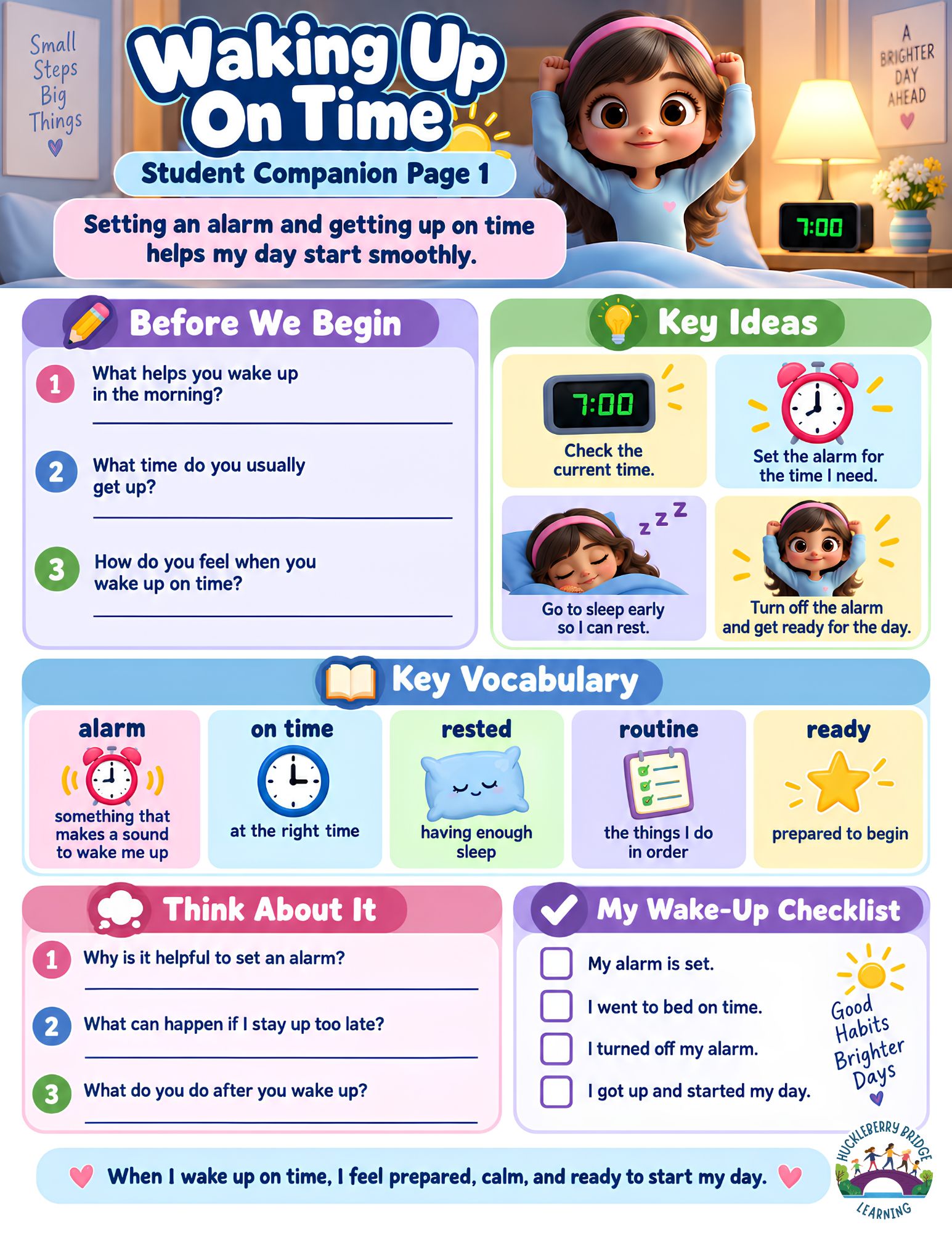
  1. Understand the purpose of using an alarm to wake up on time
  2. Learn how to set an alarm on a clock or phone
  3. Recognize the importance of going to bed early to feel rested
  4. Practice the steps for waking up: turn off alarm, get up, start the day
  5. Identify morning routines that follow waking up (e.g., brushing teeth, getting dressed)
  6. Build independence and responsibility through consistent wake-up habits
  7. Feel confident in managing time and preparing for the day ahead

Kindergarten
CCSS.ELA-LITERACY.SL.K.1 – Participate in collaborative conversations
CCSS.ELA-LITERACY.SL.K.4 – Describe familiar routines and experiences
CCSS.ELA-LITERACY.L.K.6 – Use words and phrases to describe daily activities

Grade 1
CCSS.ELA-LITERACY.SL.1.1 – Participate in conversations with peers and adults
CCSS.ELA-LITERACY.SL.1.4 – Describe people and events with relevant details
CCSS.ELA-LITERACY.L.1.6 – Use acquired vocabulary to describe routines and responsibilities

Grade 2
CCSS.ELA-LITERACY.SL.2.1 – Participate in collaborative conversations
CCSS.ELA-LITERACY.SL.2.4 – Recount key steps in personal routines with detail
CCSS.ELA-LITERACY.L.2.6 – Use domain-specific words to describe time and daily responsibilities

Grade 3
CCSS.ELA-LITERACY.SL.3.1 – Engage in collaborative discussions
CCSS.ELA-LITERACY.SL.3.4 – Report on a topic or process with relevant facts and examples
CCSS.ELA-LITERACY.L.3.6 – Use vocabulary to express time management and daily habits

Grade 4
CCSS.ELA-LITERACY.SL.4.1 – Participate effectively in group discussions
CCSS.ELA-LITERACY.SL.4.4 – Present ideas clearly and in sequence
CCSS.ELA-LITERACY.L.4.6 – Use academic vocabulary to explain routines and self-regulation

Grade 5
CCSS.ELA-LITERACY.SL.5.1 – Participate in structured discussions and share personal strategies
CCSS.ELA-LITERACY.SL.5.4 – Summarize or explain routines clearly and logically
CCSS.ELA-LITERACY.L.5.6 – Use topic-appropriate vocabulary to describe organization and planning

Grade 6
CCSS.ELA-LITERACY.SL.6.1 – Engage in collaborative discussions
CCSS.ELA-LITERACY.SL.6.2 – Interpret key points from routines and instructions
CCSS.ELA-LITERACY.L.6.6 – Use precise language to explain processes and daily responsibilities

Grade 7
CCSS.ELA-LITERACY.SL.7.1 – Engage in focused discussions with peers
CCSS.ELA-LITERACY.SL.7.4 – Present ideas clearly, using appropriate tone and examples
CCSS.ELA-LITERACY.L.7.6 – Use precise and relevant language when discussing time and habits

Grade 8
CCSS.ELA-LITERACY.SL.8.1 – Initiate and participate in collaborative discussions
CCSS.ELA-LITERACY.SL.8.2 – Analyze and explain information about daily organization and routines
CCSS.ELA-LITERACY.L.8.6 – Use clear and appropriate vocabulary to describe personal responsibility

  • The student will sequence the steps for setting and using an alarm in the correct order with 80% accuracy in 4 out of 5 structured activities by [date].
  • The student will describe why waking up on time is important using one or more complete sentences in 3 out of 4 therapy discussions by [date].
  • The student will identify one personal routine that happens after waking up in 4 out of 5 naming or sorting tasks by [date].
  • The student will demonstrate how to respond to an alarm (turn off, get up, start routine) during a role-play in 4 out of 5 opportunities by [date].
  • The student will reflect on one way waking up on time helps them feel more confident or prepared in 3 out of 4 sessions by [date].
  • The student will complete a morning routine checklist (real or simulated) in 4 out of 5 trials with minimal prompts by [date].

Related Companion Activity