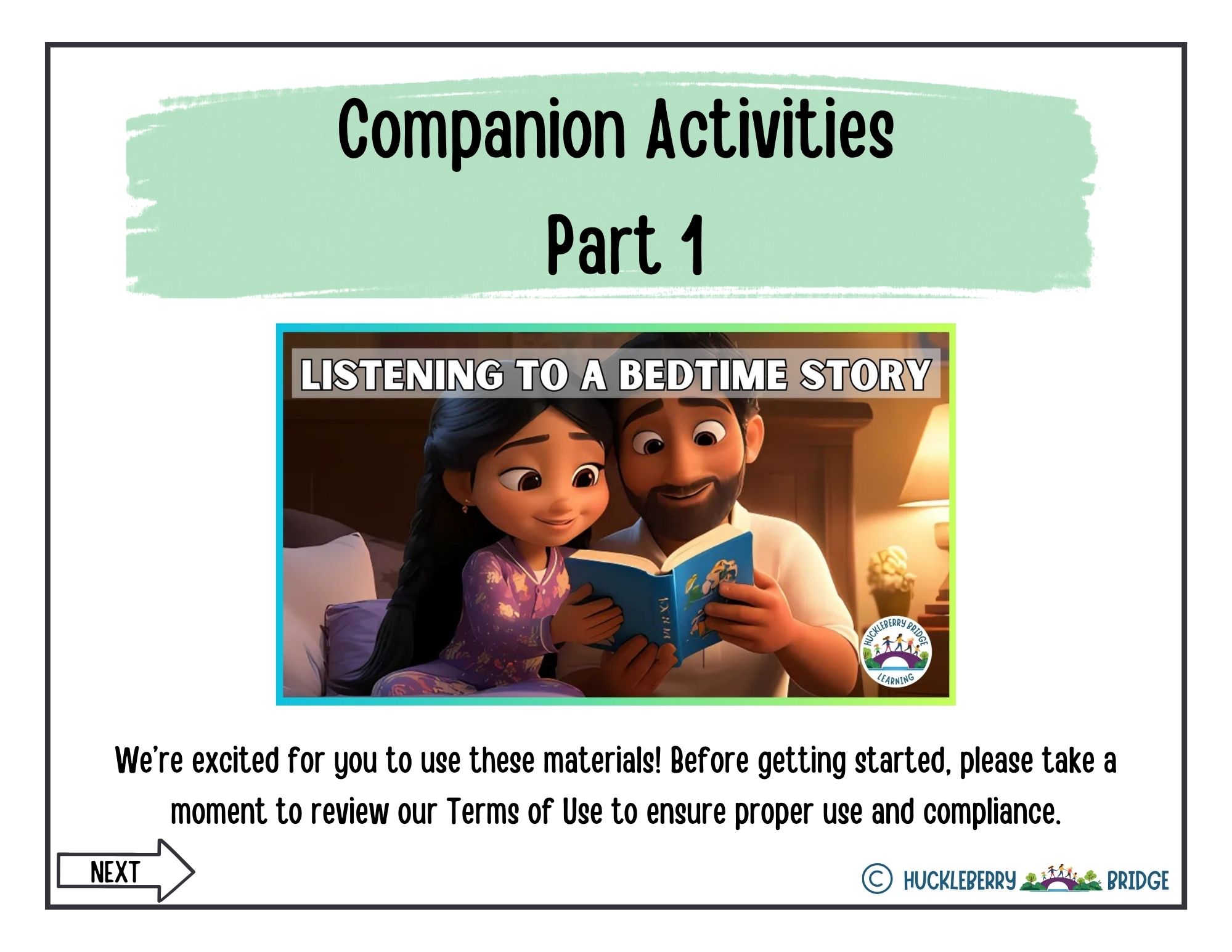
Listening to a Bedtime Story

Daily Routines

Pre-K, Elementary

Learning Objectives
  1. Understand how listening to a story is part of a calm bedtime routine
  2. Demonstrate attention and engagement while listening to a story
  3. Use pictures and words to help understand a story’s meaning
  4. Ask and answer simple questions about the story being read
  5. Recognize the emotional benefits of shared reading time
  6. Use polite and kind language to thank a reader and end the activity
  7. Connect storytime with feelings of peace, comfort, and readiness for sleep

Kindergarten
CCSS.ELA-LITERACY.RL.K.1 – Ask and answer questions about key details in a text
CCSS.ELA-LITERACY.RL.K.7 – Describe the relationship between illustrations and story
CCSS.ELA-LITERACY.SL.K.2 – Confirm understanding of read-alouds by asking/answering questions
CCSS.ELA-LITERACY.L.K.6 – Use vocabulary acquired through reading and conversation

Grade 1
CCSS.ELA-LITERACY.RL.1.1 – Ask and answer questions about key story details
CCSS.ELA-LITERACY.RL.1.7 – Use illustrations to describe characters, setting, or events
CCSS.ELA-LITERACY.SL.1.2 – Ask and answer questions about read-alouds
CCSS.ELA-LITERACY.L.1.6 – Use words and phrases from reading and conversations

Grade 2
CCSS.ELA-LITERACY.RL.2.1 – Ask and answer who, what, where, when, why, and how questions
CCSS.ELA-LITERACY.RL.2.7 – Use information from illustrations and words to understand the story
CCSS.ELA-LITERACY.SL.2.2 – Recount or describe key ideas from a read-aloud
CCSS.ELA-LITERACY.L.2.6 – Use acquired vocabulary to describe emotions and experiences

Grade 3
CCSS.ELA-LITERACY.RL.3.1 – Ask and answer questions to demonstrate understanding
CCSS.ELA-LITERACY.SL.3.2 – Determine the main ideas and details of a read-aloud
CCSS.ELA-LITERACY.L.3.6 – Use language to describe stories, routines, and emotions

Grade 4
CCSS.ELA-LITERACY.SL.4.2 – Paraphrase portions of spoken text or read-alouds
CCSS.ELA-LITERACY.L.4.6 – Use academic vocabulary to express experiences and routines

Grades 5–8
(Though more advanced, this video can support functional listening and conversation skills in older students needing foundational practice)
CCSS.ELA-LITERACY.SL.5.1–8.1 – Engage in collaborative discussions, listen actively
CCSS.ELA-LITERACY.SL.5.2–8.2 – Summarize, interpret, or respond to spoken content
CCSS.ELA-LITERACY.L.5.6–8.6 – Use language that reflects an understanding of routine experiences and feelings

  • The student will listen to a short read-aloud and answer one or more comprehension questions with 80% accuracy in 4 out of 5 sessions by [date].
  • The student will describe one or more elements of a story (e.g., characters, setting, events) using complete sentences with minimal cues by [date].
  • The student will ask one relevant question during or after a shared reading activity in 3 out of 4 structured opportunities by [date].
  • The student will identify one feeling word that describes how they felt during or after storytime in 4 out of 5 therapy activities by [date].
  • The student will follow a 3-step bedtime story routine (e.g., pick book, listen, say thank you) independently in 4 out of 5 structured sessions by [date].
  • The student will express appreciation after a shared activity (e.g., “Thank you for reading to me”) in 4 out of 5 opportunities by [date].

Related Companion Activity